Nurturing AgroEcology in Urban Life
A strategy for living alongside food production
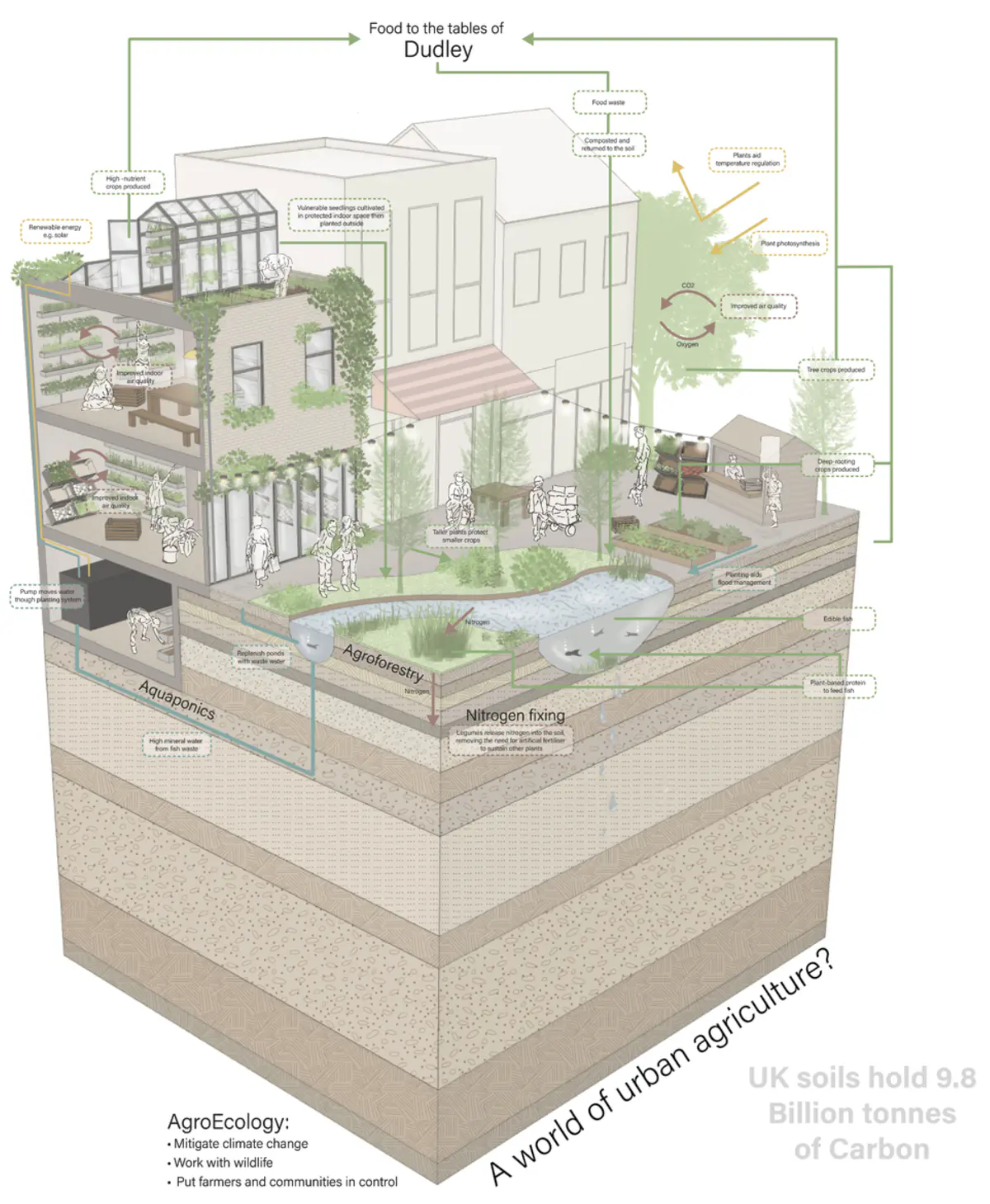
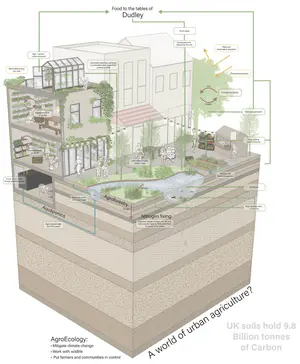
A critical part of the climate crisis is the degradation of soil, leading to scientists predicting the UK has approximately 100 harvests left of stable crop production. As an attempt to address the problem this project will explore the possibility of integrating sustainable agriculture into an urban setting, reducing the strain on agricultural land, reducing food miles and widening city biodiversity. Taking guidance from the farming movement, ‘Agroecology,’ a climate conscious, wildlife supporting and community engaged closed loop system will be developed, combining traditional growing with technology driven techniques that will support each other to produce a diverse plate.
Dudley High Street will be the focal point, reinvented as a destination not just for the purchase and consumption of food but also its creation, driven by the needs and engagement of local people. Connecting the community to the food they eat.
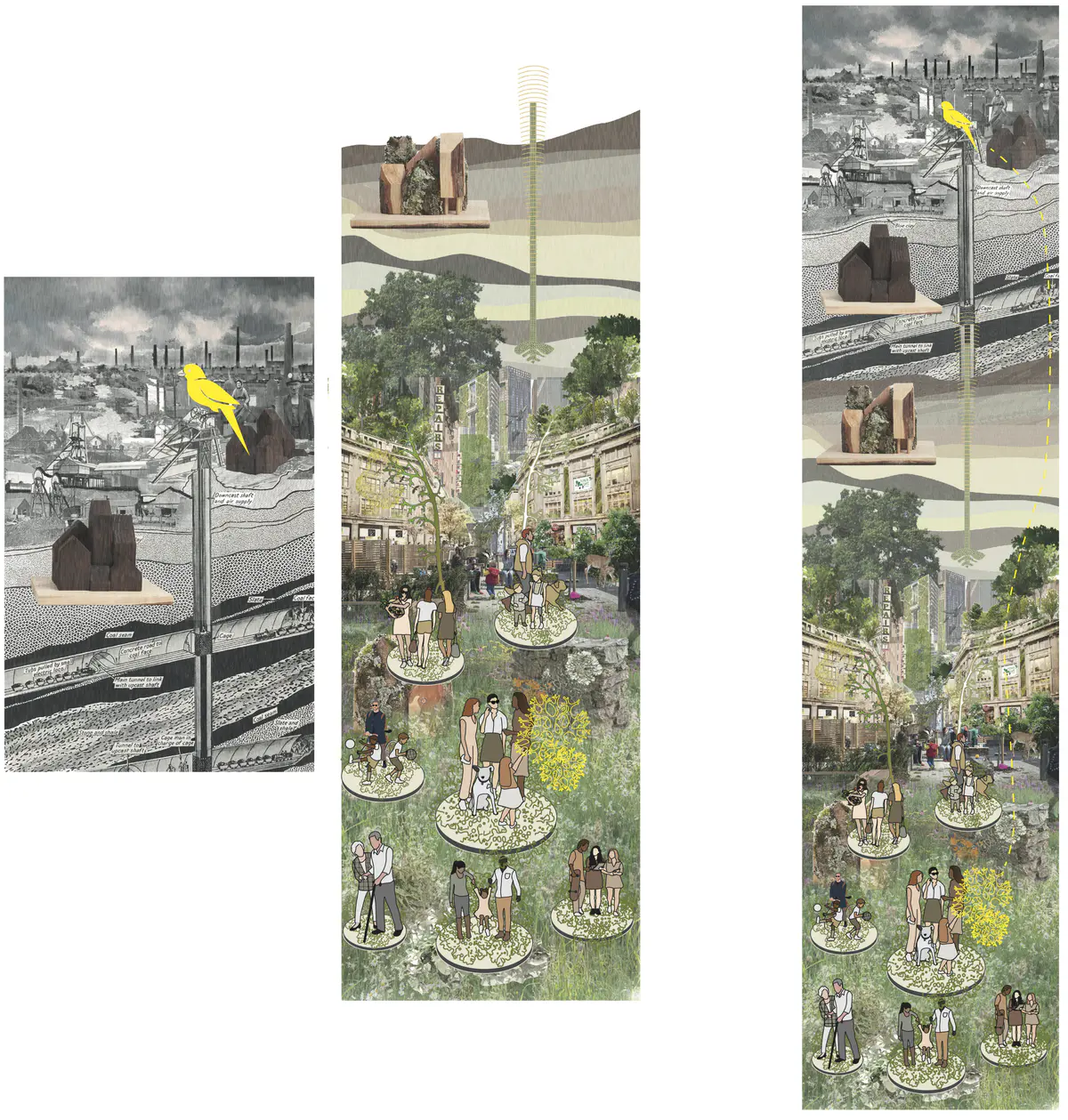
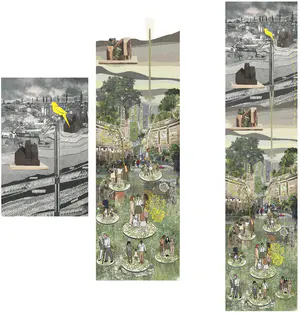
The yellow canary of the mines, a symbol of protection for miners spending time in highly polluted areas. The yellow lichen becomes the new symbol for Dudley, protecting inhabitants through carbon sequestration & clean air.
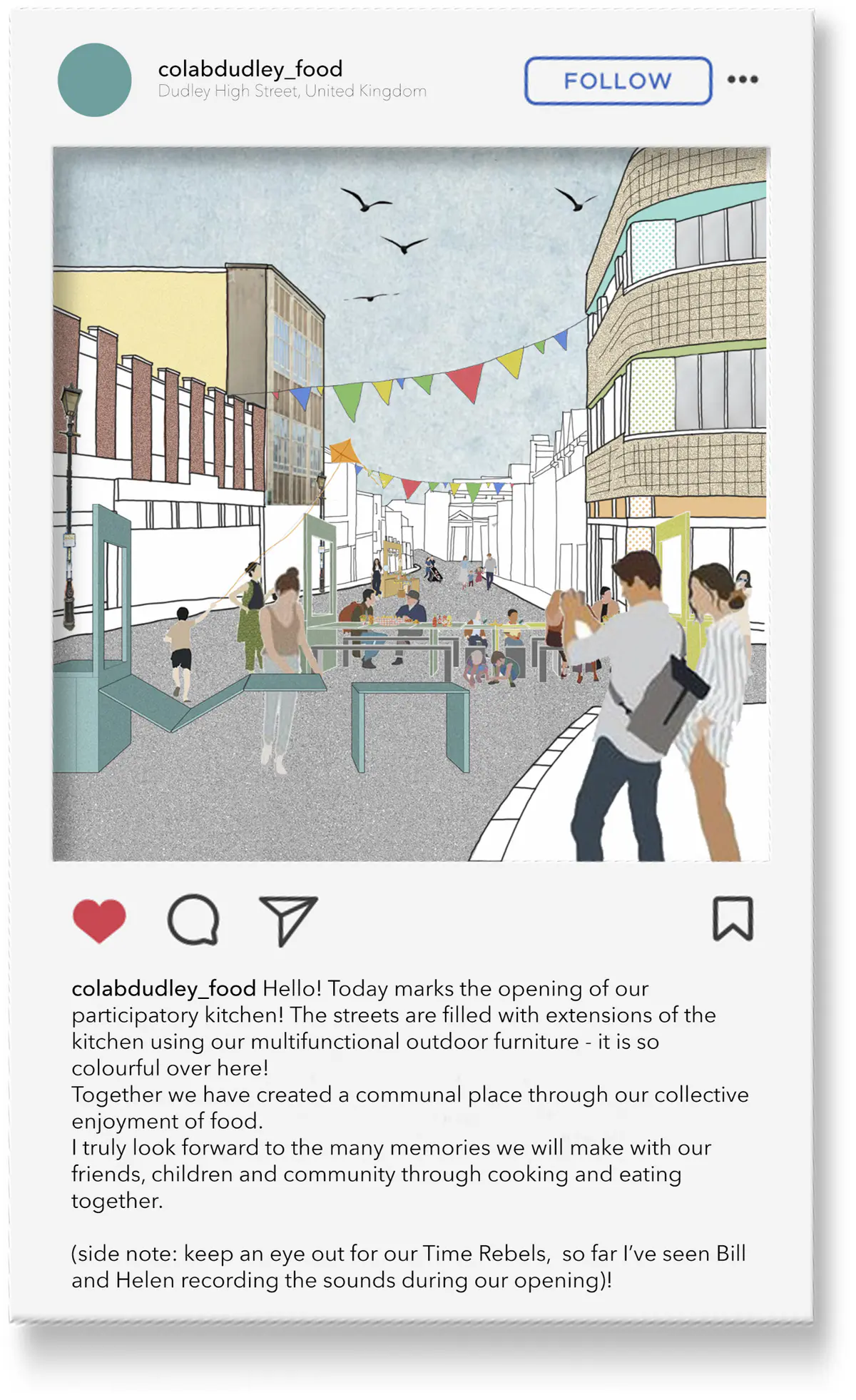
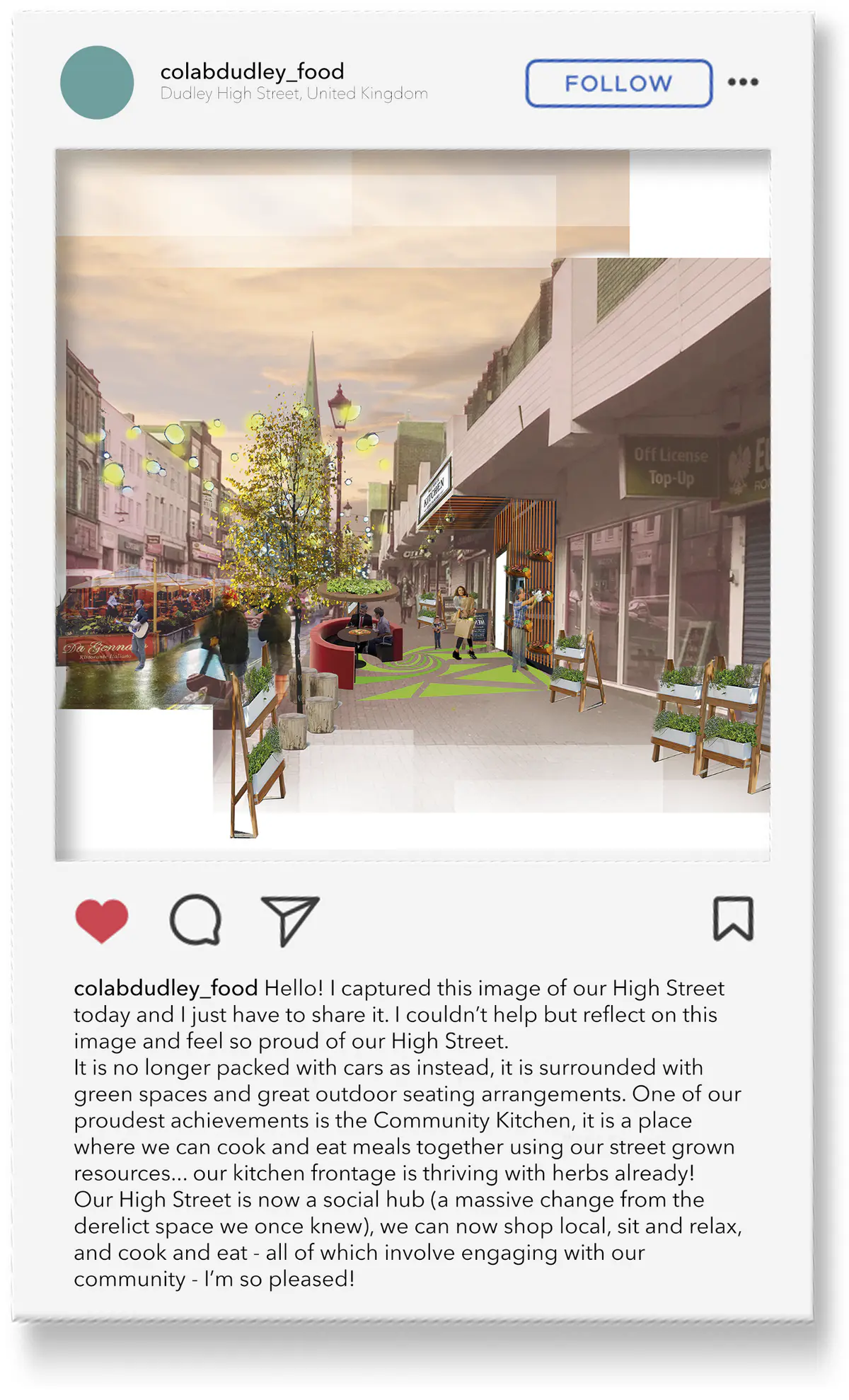
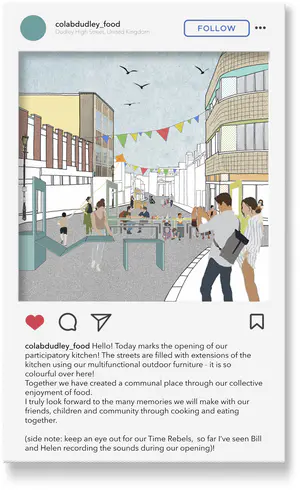
In this post, we captured the street’s atmosphere filled with colour, activity, and pedestrianised streets.
(We decided to present our narrative through social media and instagram posts as we wanted to showcase what individual experiences might be like when experiencing the future High Street. Each of our posts captures a different element of experience on the High Street to form a collective scenario.)
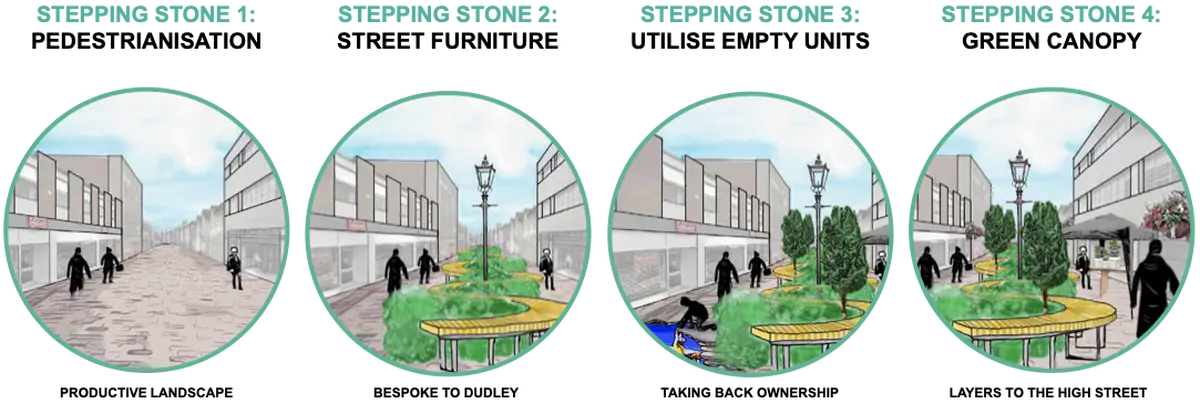
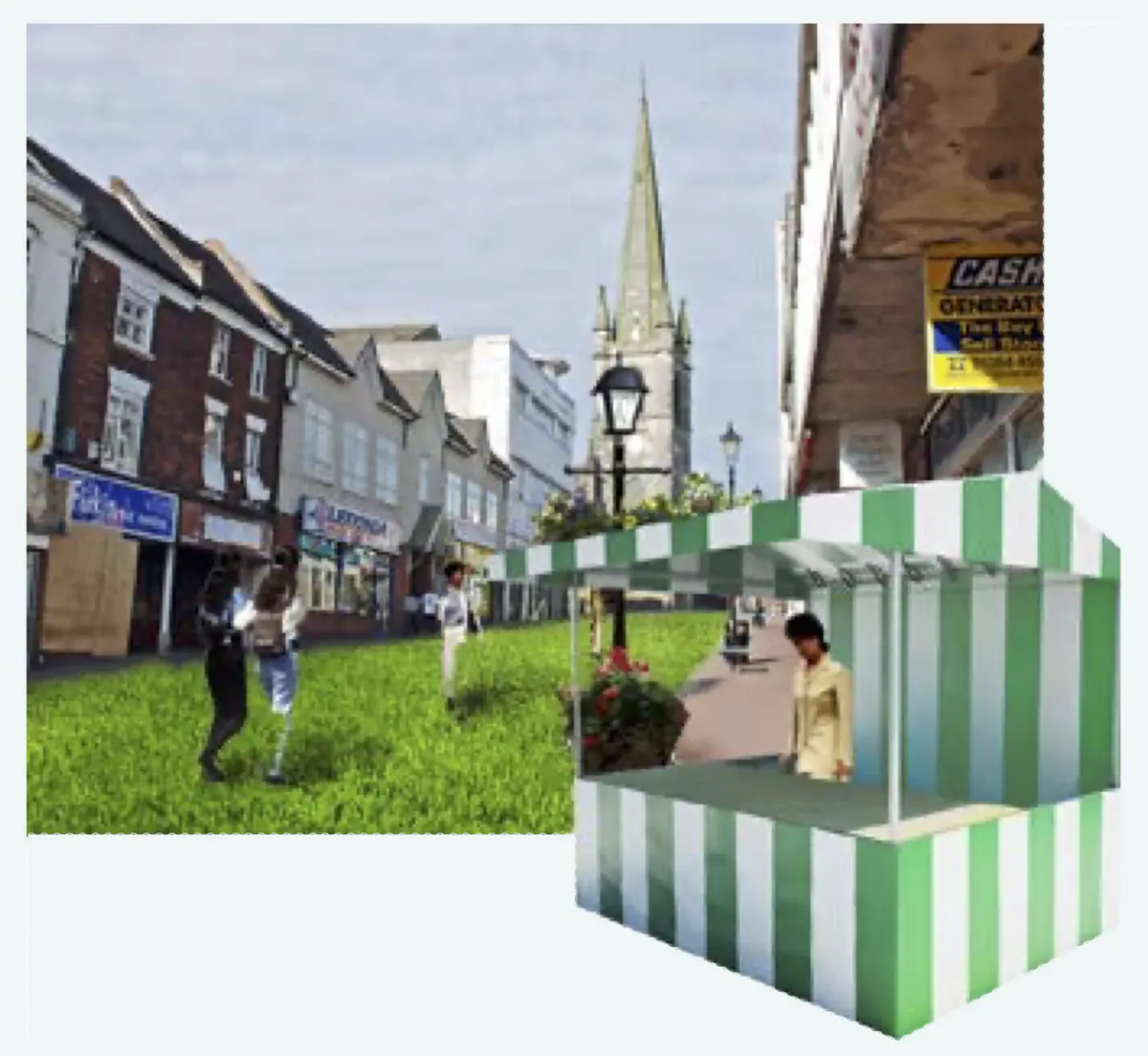
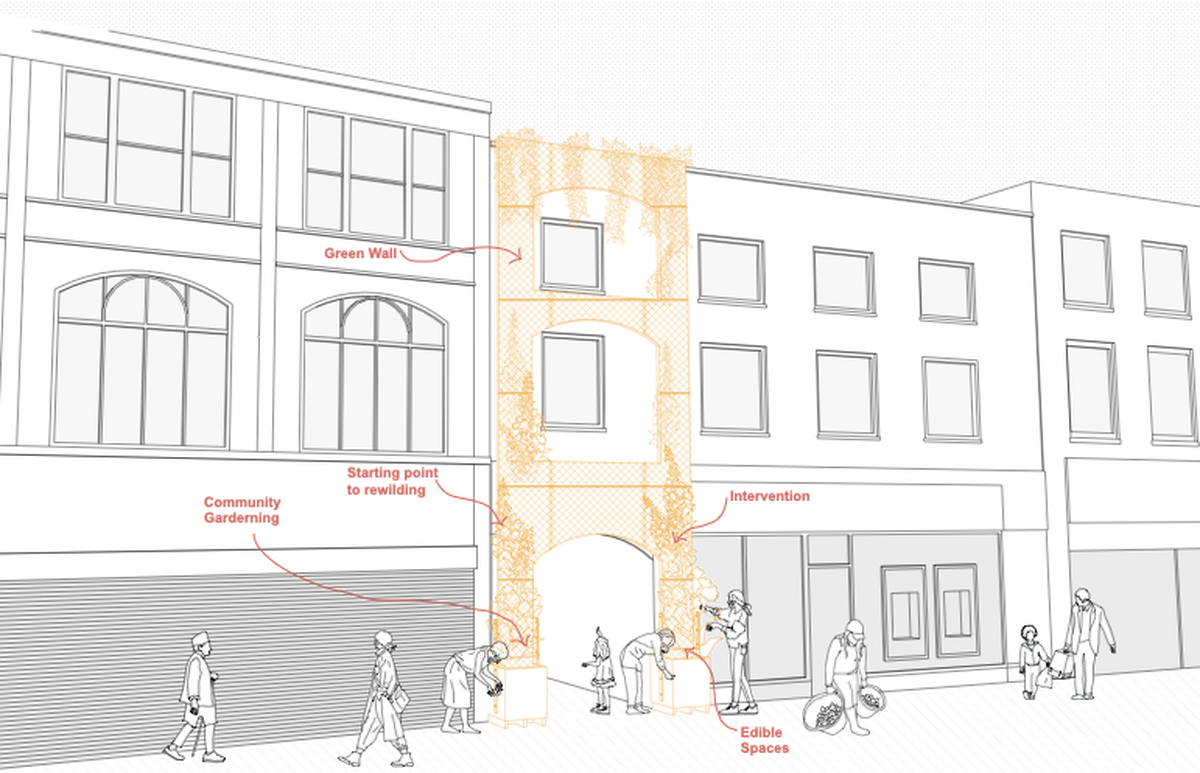
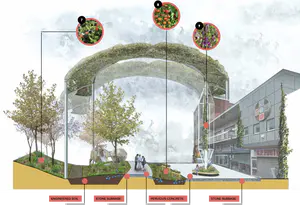
This visual represents Dudley High Street re-imagined; a new vision of a re-wilded, food-centric town centre. The green canopy will begin as a frame that will encourage the growth of plants. Smaller scale units will be integrated at the start and build towards the final vision.
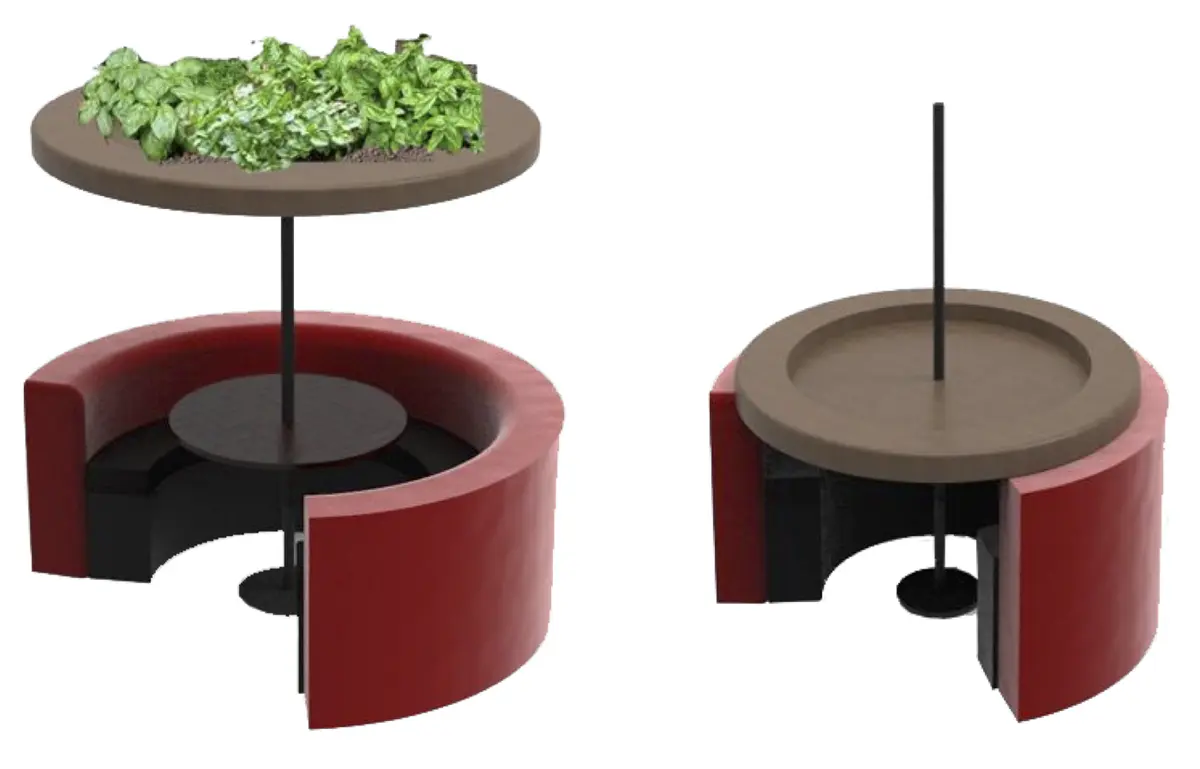
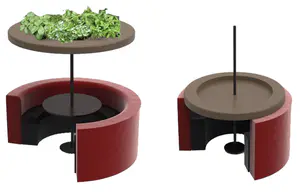
The fourth Stepping Stone project focused on the design of 2-in-1 flower pot seating for the exterior of the community kitchen. The design also integrates a canopy for growing herbs to also use in the kitchen. Through a collaboration with another Time Rebel collecting reusable waste, we thought about how this could be integrated into the materiality of this concept. The product analysis of this design is that it has a detachable seat to cater for a variety of arrangements. The flower pot can be raised to create a seating area, and lowered to be become a flower pot on the High Street.
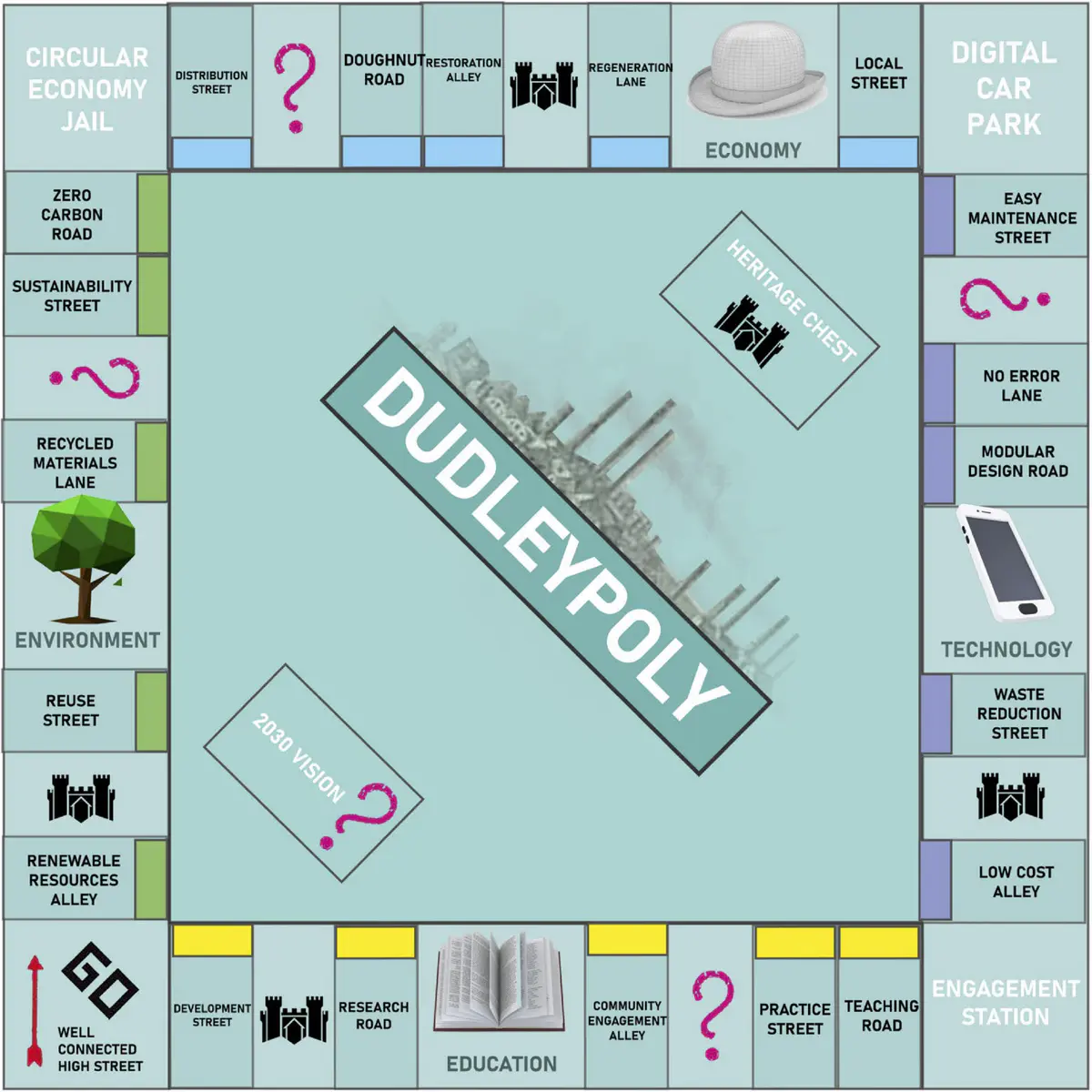
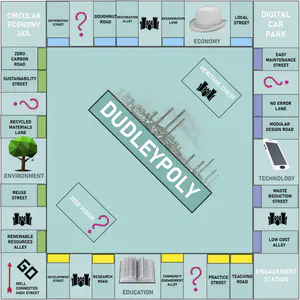
We created a visual representation of the main factors and sectors we came across in our research and explored individually: environment, economy, technology and education. It also summarises our goal of creating a connected High Street, and the steps we took to achieve this goal.
The population of Dudley in 2021 is circ. 80,000 and including the wider borough totals 313,000.
For one person on the average diet, roughly 2.6 Hectares of farm land is required. A family of four, just over 10 Hectares. A population of 313,000 required 813,800 Hectares, the equivalent of 1,162 football fields or 707,652,174 car parking bays.
FEEDING DUDLEY REQUIRES 1,162 FOOTBALL FIELDS OF FARM LAND
Thesis Concept Image - The Farm House
Taking a fun and more literal approach for providing local food production onto the high street, I looked at layering a farm growing different fruits, vegetables and meat products into the same structure to view the absurdity of growing, processing and packaging within a single structure. Ultimately the project would be as close to being a closed system as possible, where food grown could be fed to the animals and the waste from the animals will be used as fertiliser from the food. Air flow and lighting would not only be critical for the animals, but it also allows the fruit and vegetables to grow faster and more efficiently.
The processes within the Farm House would be very energy intense due to the amount of heating, water and lighting that will be required to house the animals and grow the crops. The project utilises conventional farming methods, ploughing, seeding etc., but without the harmful pesticides that would be usually applied. The farming problem of space efficiency is partially targeted in this proposal. Per m2 in plan does contain a greater yield due to the floor layering, however per m2 of gross internal floor area the yield efficiency remains. To ultimately increase overall yield per m2 aeroponics should be applied to massively increase yield and decrease water consumption.
THESIS PROPOSAL
The redevelopment of the high street is a re-envisaged perception of what the high street is and what it will become. A future look at what the high street will become, with mixed use residential and food growth structure to create dense living accommodation and localised food growth which prevents the need to contribute to deforestation and loss of biodiversity from urbanisation.
As part of the schemes wider aims, the high street and surrounding roads will become part of a network of green corridors, where pedestrian footfall/cycling can increase and the use of polluting vehicles will be greatly reduced. The idea of greatly increasing the density of vegetation along roads and reducing lanes will not only improve the rate of absorbing carbon dioxide, but also reduce noise and reduce temperature spots. The Miyawaki planted method would be used where ever possible to create dense areas of trees and shrubs, as well as quickly create new living conditions for new biodiversity.
The primary focus for the building will be the localised food growth in the vertical farms, several floors of food growth will create a new economy centred around the high street, removing the need to import fresh food from farms from across the country or on the other side of the world. The environment within the farms will be climate controlled, allowing the farms to adjust their climate to the optimum for the specific food. The density at which food can be grown in is almost 400 times greater than conventional farming, which greatly reduces the need to create new farms.
The residential aspects pairs with the farm, in bringing a new generation of people to live above the high street. The new vision of the high street would become an attraction point for people to not only visit but to live in as well. Access to land converted from roads and paving to nature will create value and attraction to the area once again. Eventually the low income stores will transition to stores that cater to the new environment.
This project targets all the XR themes directly or indirectly.
Air & Biodiversity - Creating new and preventing the loss of woodland and habitats.
Food - Growing food local and a much greater yield.
Water - Greatly reducing the resource requirement during farming.
Materiality - Managing sustainable usage of the deconstructed buildings and sourcing of the proposed.
Community - Creating new environments for communities to interact with each other.
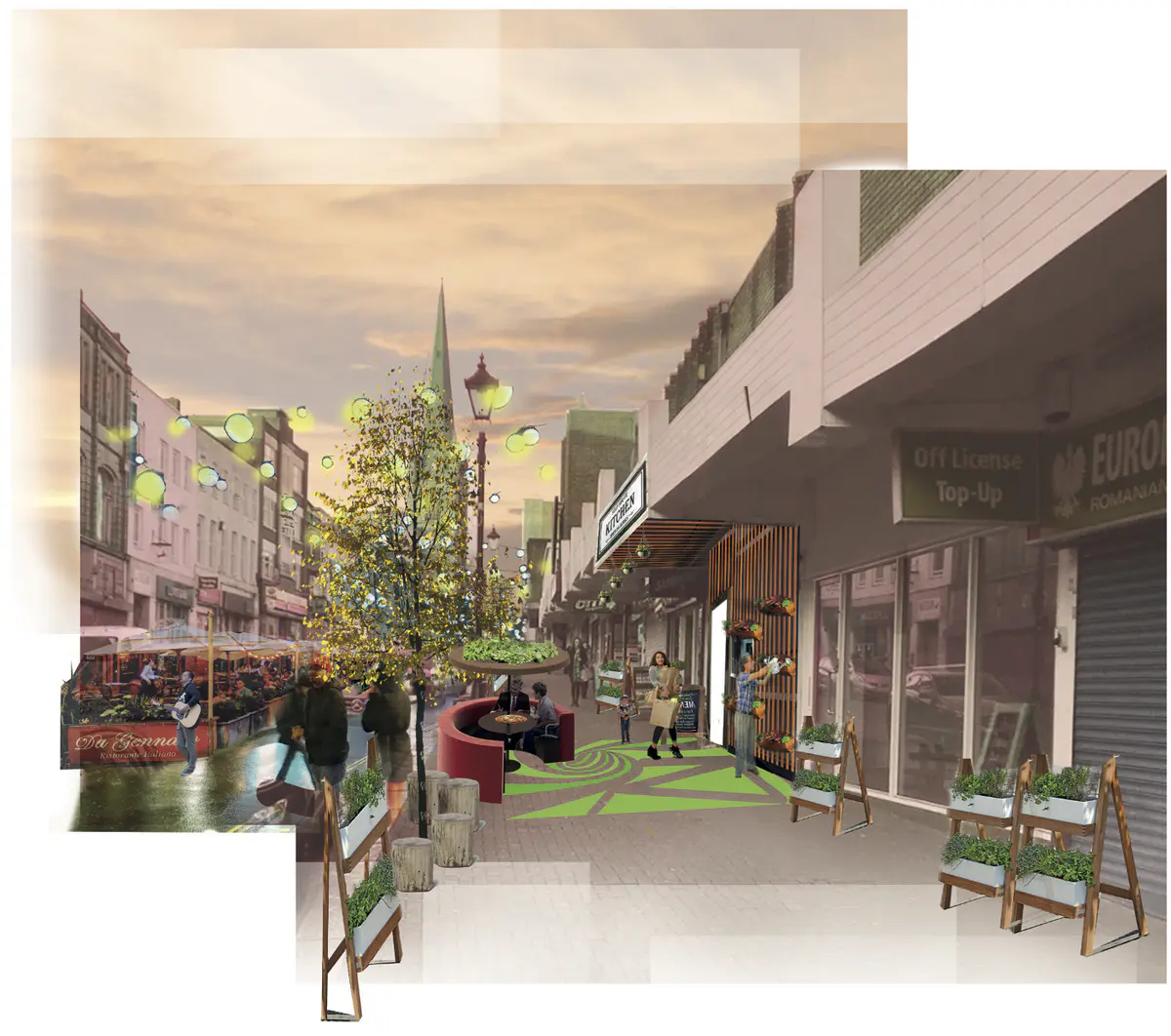
It is 5pm in the evening and the shops are still full with customers. David has had a long and busy working day at the shop and can now finally take a break, and so he ventured out onto the street to get fresh air. David randomly bumped into an old customer, they both instantly recognised each other, and decided to share some conversations on a nearby bench. The old customer could not stop pointing out many of positive changes on the High Street since he last visited. He noticed the fresh air from more vegetation and less pollution, outdoor seating and a thriving enjoyable space.
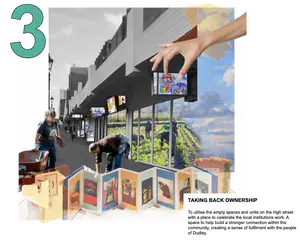
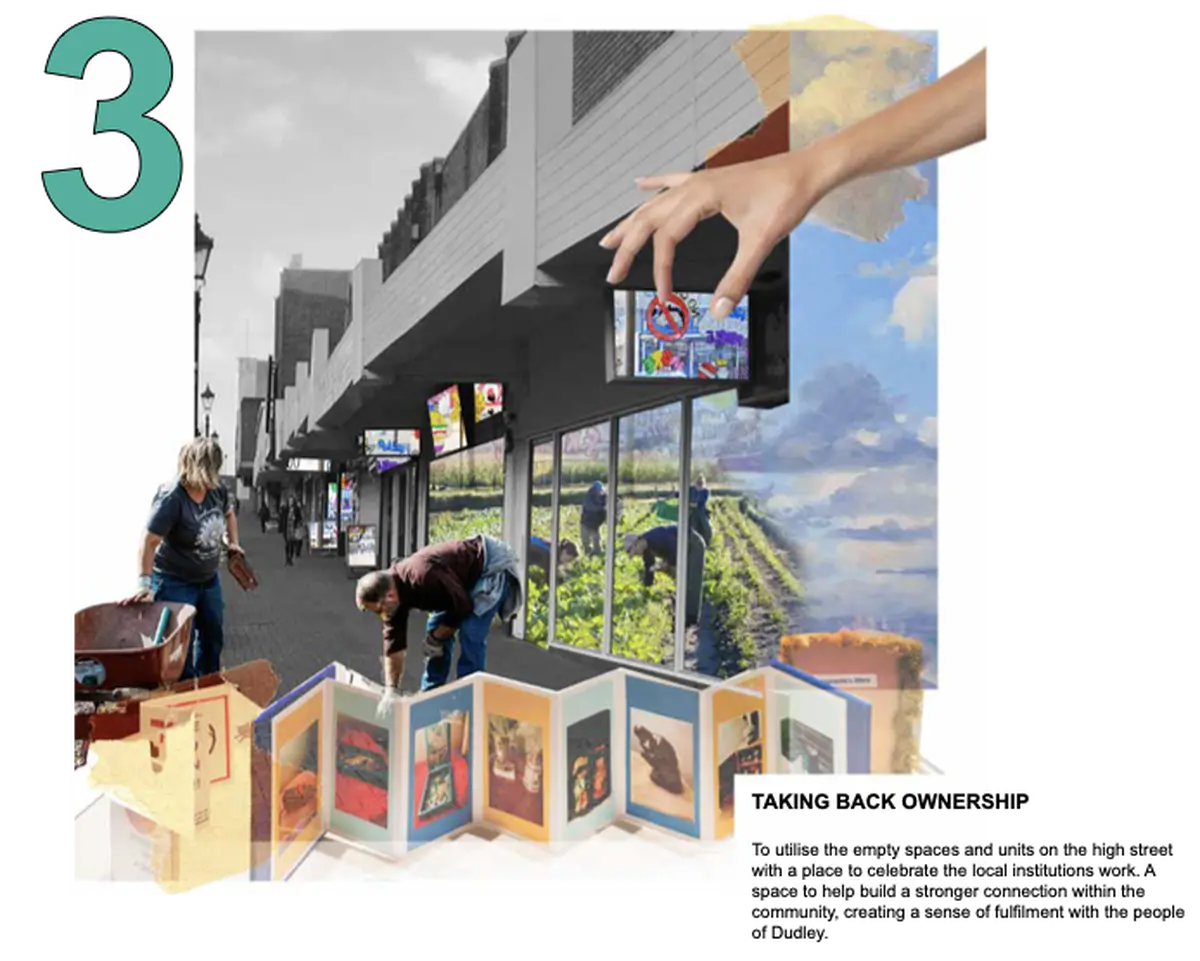
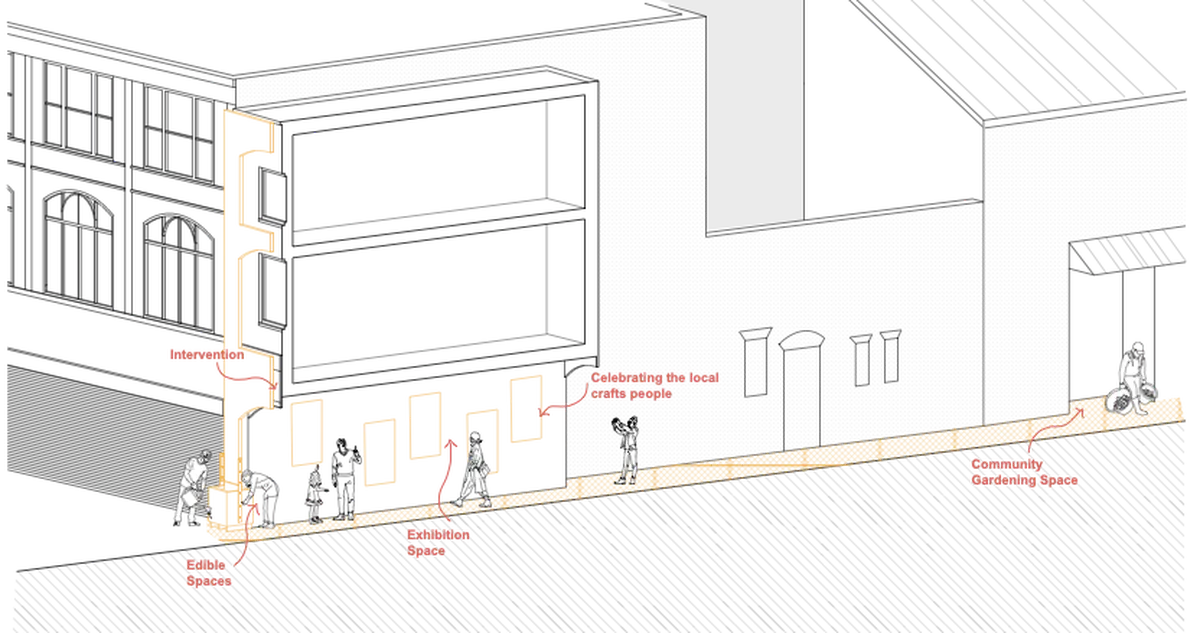
TAKING BACK OWNERSHIP - To utilise the empty spaces and units on the high street with a place to celebrate the local institutions work. A space to help build a stronger connection within the community, creating a sense of fulfilment with the people of Dudley.
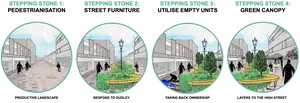
These are stepping stones that we wanted to achieve, with a scale of intervention, starting with small changes that could still have a big impact e.g. street furniture. At the other end of the scale is topography, where larger adaptations can be made for what we want to achieve.
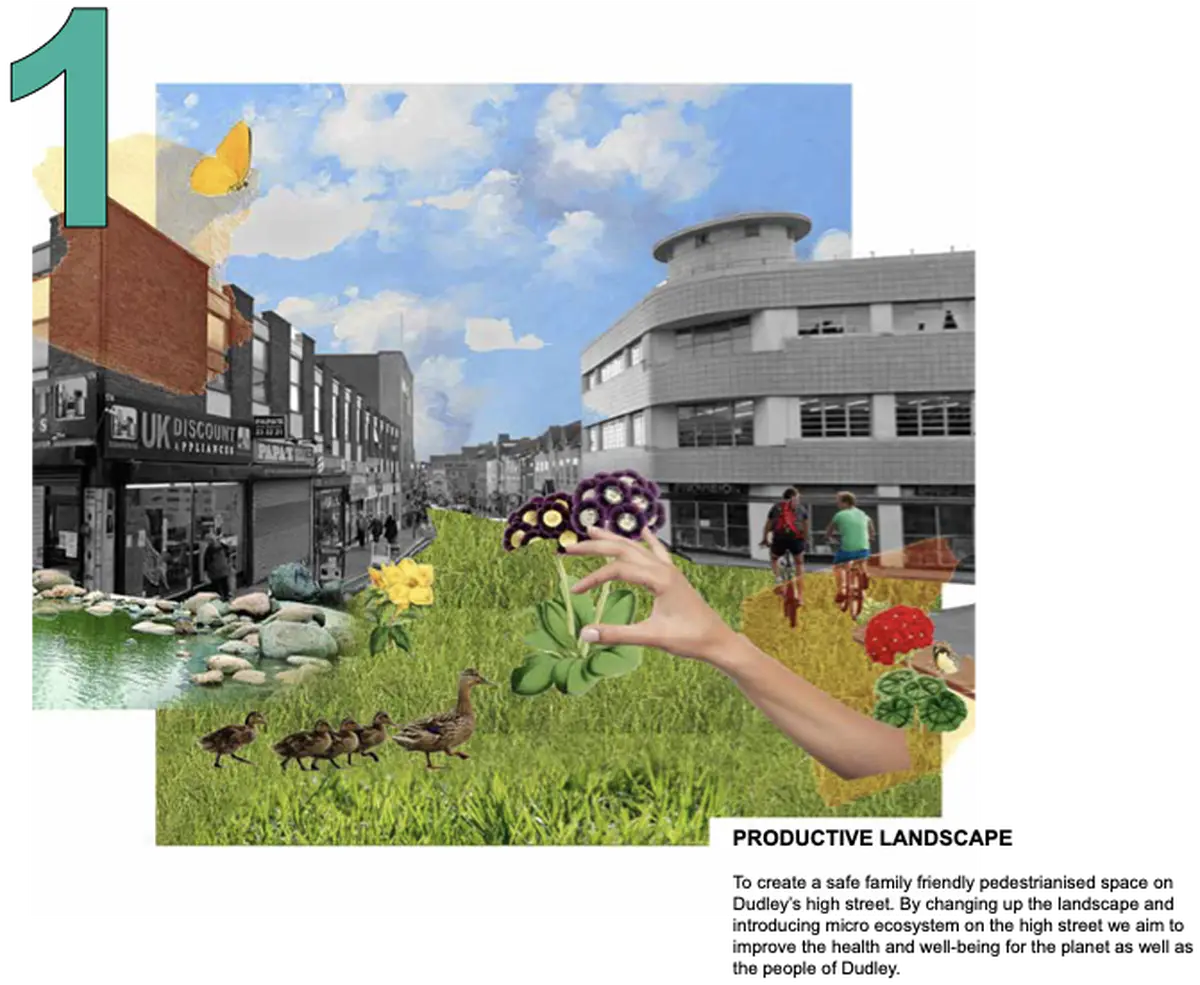
PRODUCTIVE LANDSCAPE
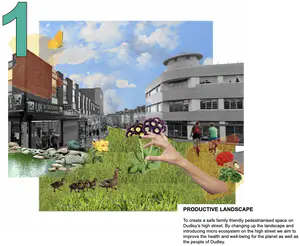
To create a safe family friendly pedestrianised space on Dudley's high street. By changing up the landscape and introducing micro ecosystem on the high street we aim to improve the health and well-being for the planet as well as the people of Dudley.
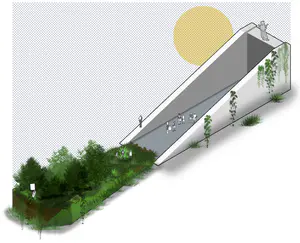
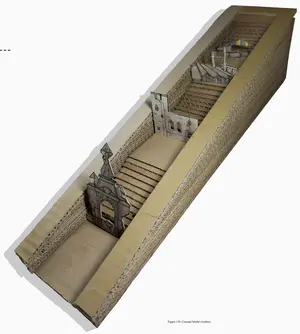
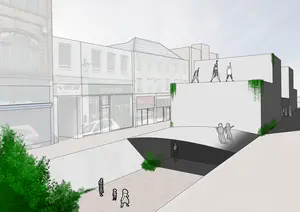
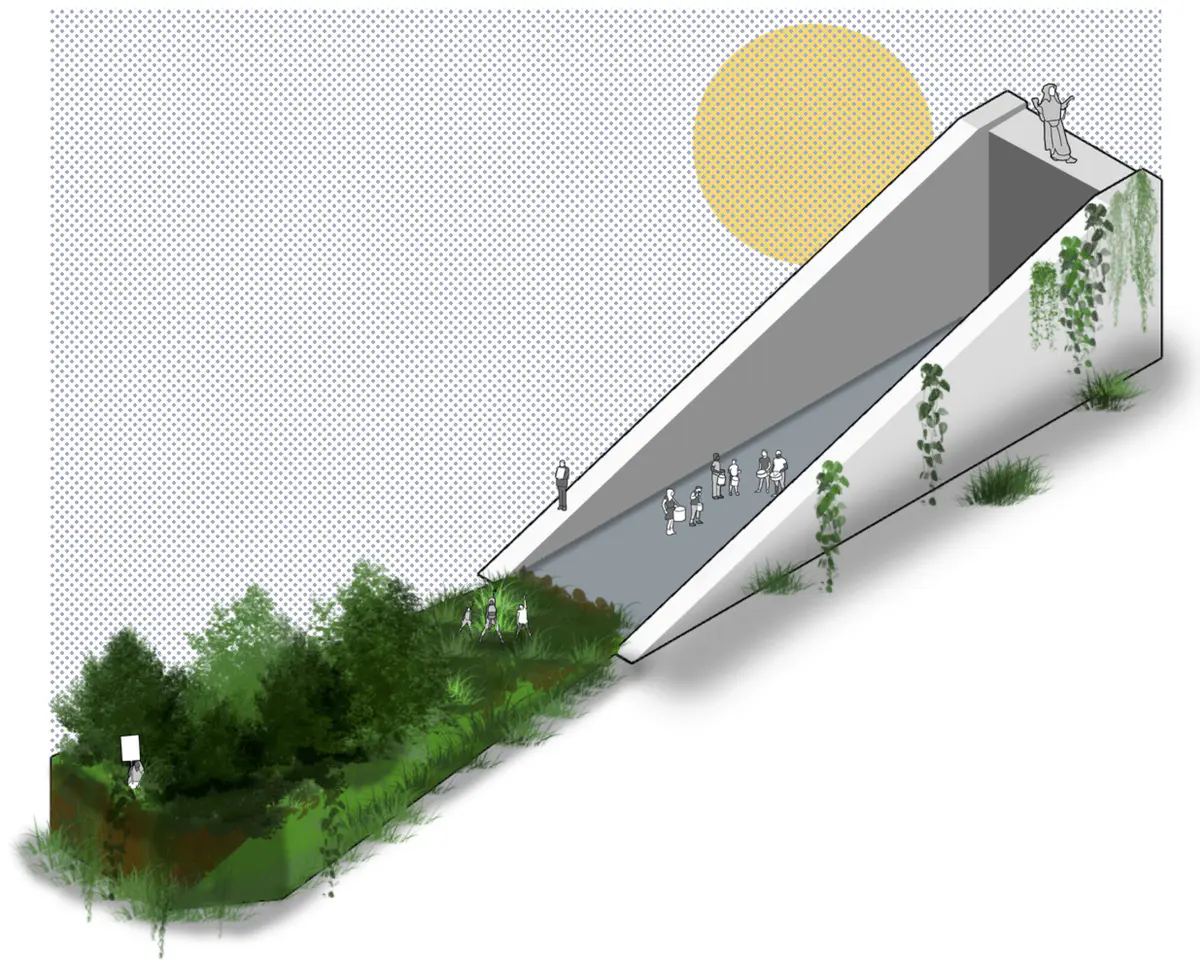
The whole High Street would be dug out to make way for this new kind of “street”. The idea, as stated, is to alter the way that people use this street, so that they can learn about the legacy of Dudley. This would mean that there would be a canopy that sits on top of the cut, that would also act as a means to shelter everything underneath, but would also be made in Dudley to promote local craftsmans. This canopy can then hold something like Theatre Curtains with the history of Dudley presented on them. As you walk through the cut, you go through all the different parts of Dudley’s Legacy - Saxon, Middle Ages, Industrial Revolution, Modern, and you would end the walk on the “Future”. You would start at one end, up by the top church, and as you walk through towards the market place, you would walk through the eras in chronological order. Then, once you exit the tunnel, you would leave the Modern era, and come out into the reclaimed green space, which would represent the future of Dudley’s Legacy. This would be a Miyawaki Forest that would be expanded out through the streets, taking over the spots where cars used to drive, to now benefit Dudley, it’s people, and the world as a whole.
Dudley’s High Street is about 240 metres long, about 9 metres wide, and rises about 8 metres. This would provided a very prominent feature for the High Street if it was dug out and recommissioned.
An added aspect to the dug out street would be that of the canopy that would reside above it. While thinking of the design, two ideas stood out - one that would stand raised, at about the same level as the end of the street, which would create this arcade styled archway that would reside high above the street. The second was having the canopy be flush with the pavement all the way up, except at the end that would then provide a small increase around the steps.
Both ideas serve the same purpose, but provide drastically different means of doing so.
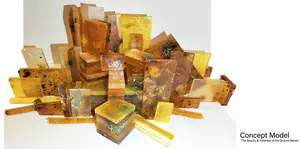
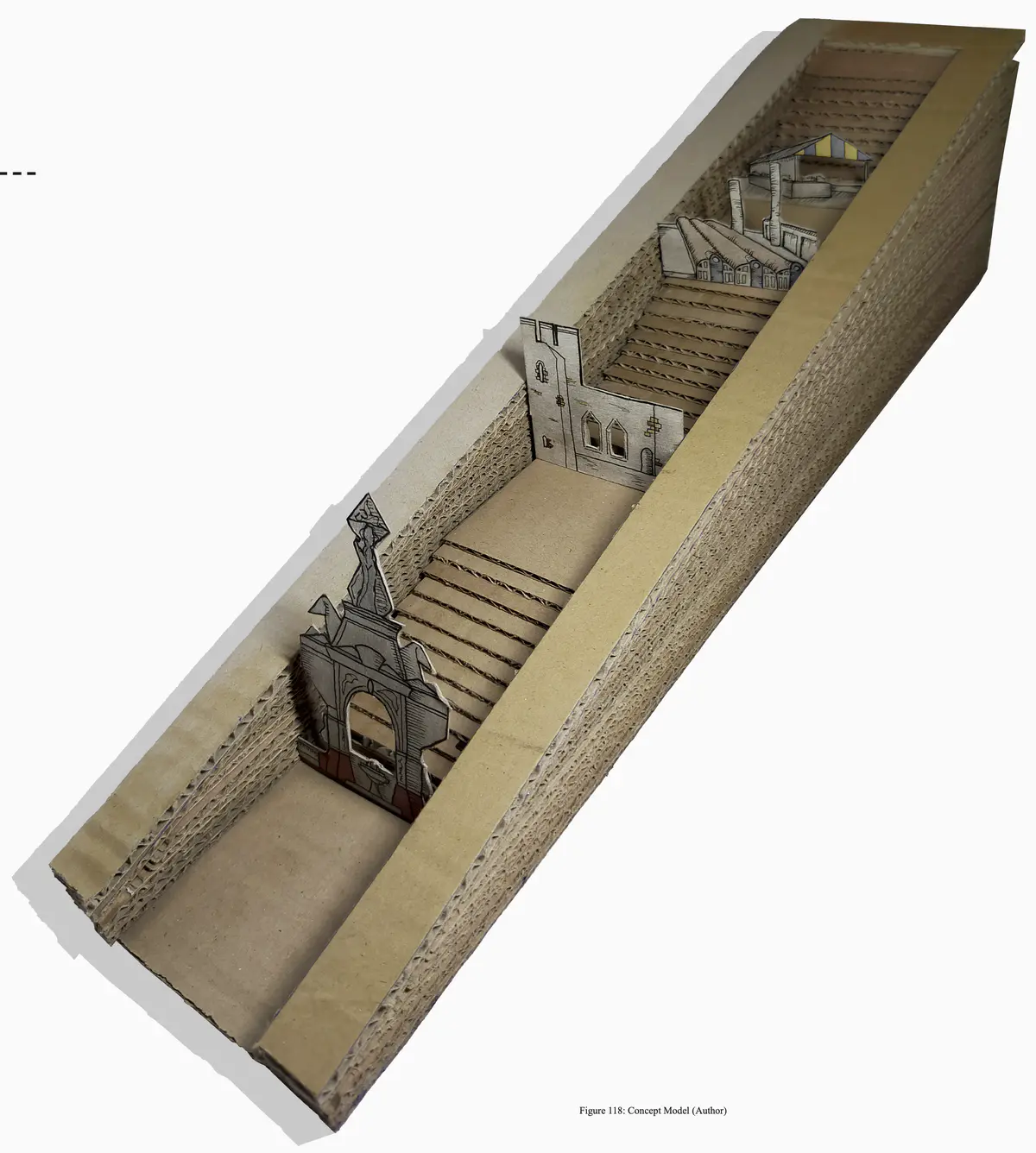
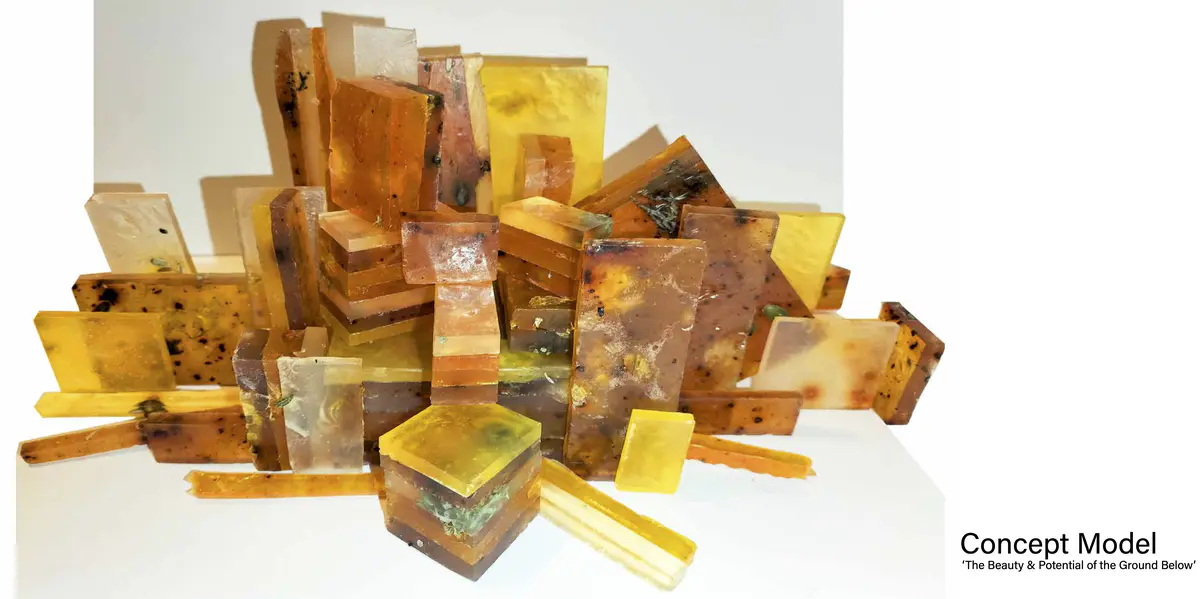
Concept Model - The model represents the idea of digging into the High Street itself. The idea was to drastically alter the form of the High Street to a point that it altered the ways that people in Dudley would live their day-to- day, changing the theatre of their lives, so that they could learn about their own history, their legacy, and about the endless possibilities of Dudley’s future. The idea was inspired by the word “Cut”, which in Black Country Dialect means “Canals”, as they were long cuts through the land.
Dudley’s fountain represents the Middle Ages, showing the growth of Dudley over time. While it was the Capital of the Black Country (and still is), the Middle Ages is when Dudley saw itself come into it’s own place, being recognised as a big market town, and slowly expanding it’s territories and influence.
The Castle represents the Dudley Castle, built in the 11th Century. Ruling over the land, the Castle is a key component of the Legacy of Dudley, sitting on the highest point for miles around, rich with history, from Being demolished twice, to the civil war, to now watching over the Zoo.
The factories represent the Industrial Revolution era of Dudley, a time when Dudley was the king of England, and basically ran the entire process. It was an important aspect of Dudley’s Legacy, and sits as probably its crowning glory - even if today we can recognise the disastrous affects it had on the world in the short period of time the era passed.
The Market represents the modern day. Dudley has seen better years, but it is with this project that I propose that even better ones are just around the corner. While people don’t look fondly at Dudley, those from there have a fierce dedication to the legacy of Dudley, which hopefully will burn to a brighter future.
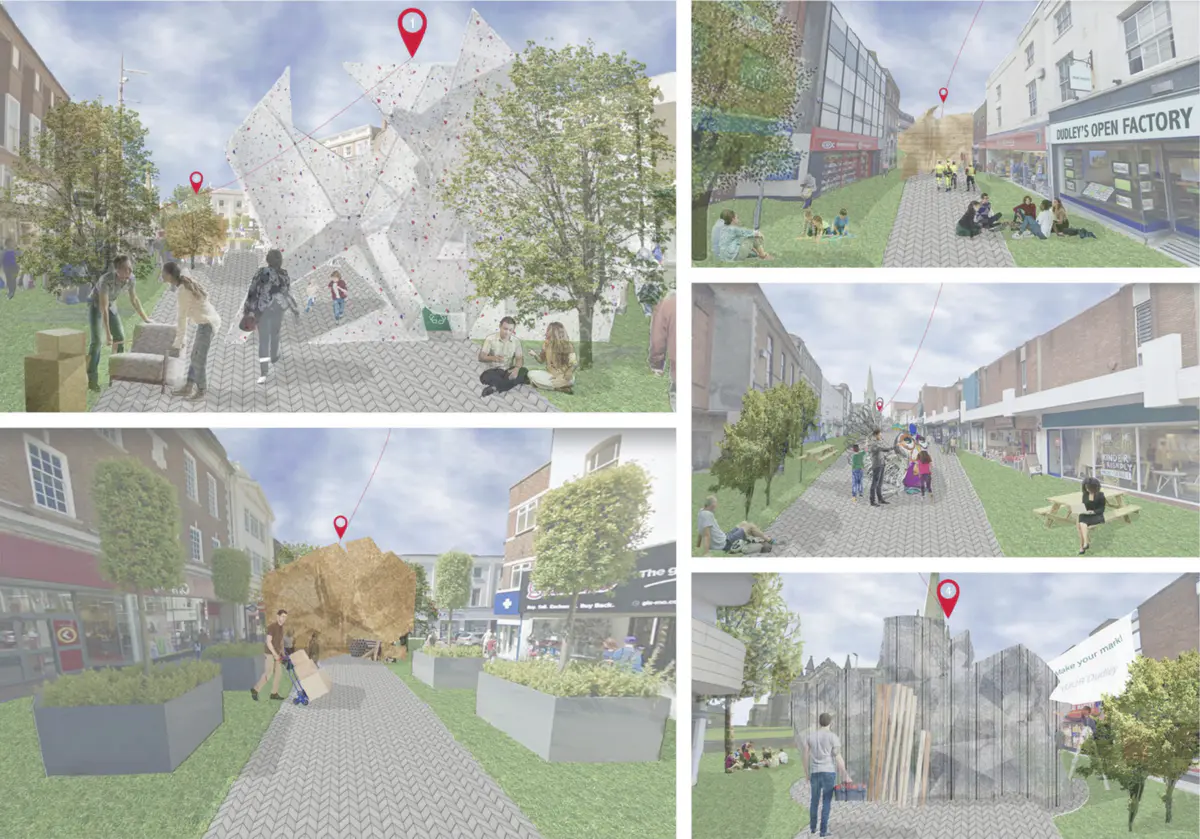
Our collective vision for Dudley is to support a creative community that is connected through our internet of things; creating spaces that allow for the collection and redistribution of materials that locals can use to construct products with. Community engagement is central to this design network with local businesses encouraged to get involved in manufacturing.
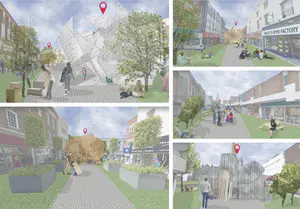
We decided to bring alive this vision through a series of pavilions positioned through the High Street, following a process through recycling, storing constructing and manufacturing. To take this idea further, we allocated several empty units along the High Street to become spaces involved in the open factory, from workshops, educational centres and co-working hubs. Since we wanted to show the journey people would be able to take, we decided to create a storyboard for our final visual.
These visuals show how the pavilions could sit in the High Street, starting at the market place, past CoLab Dudley’s base, and ending up at Top Church. We wanted to show how people would be able to interact with these different spaces and navigate between them.
Atifa lives nearby. During her free time, Atifa takes part in social work and welcomes the visitors of the High Street. Her main responsibility involves managing the food produced on street garden. A group of out of town visitors seemed lost on the street as they were wondering about what to do after shopping. Atifa suggested to participate in a workshop in the community kitchen. They plucked some berries and veggies from street and made a quick salad with a locally developed recipe that they had never tried. They thanked Atifa for the new recipe.
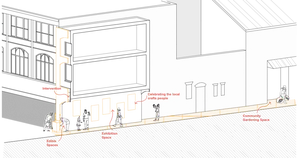
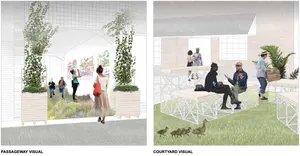
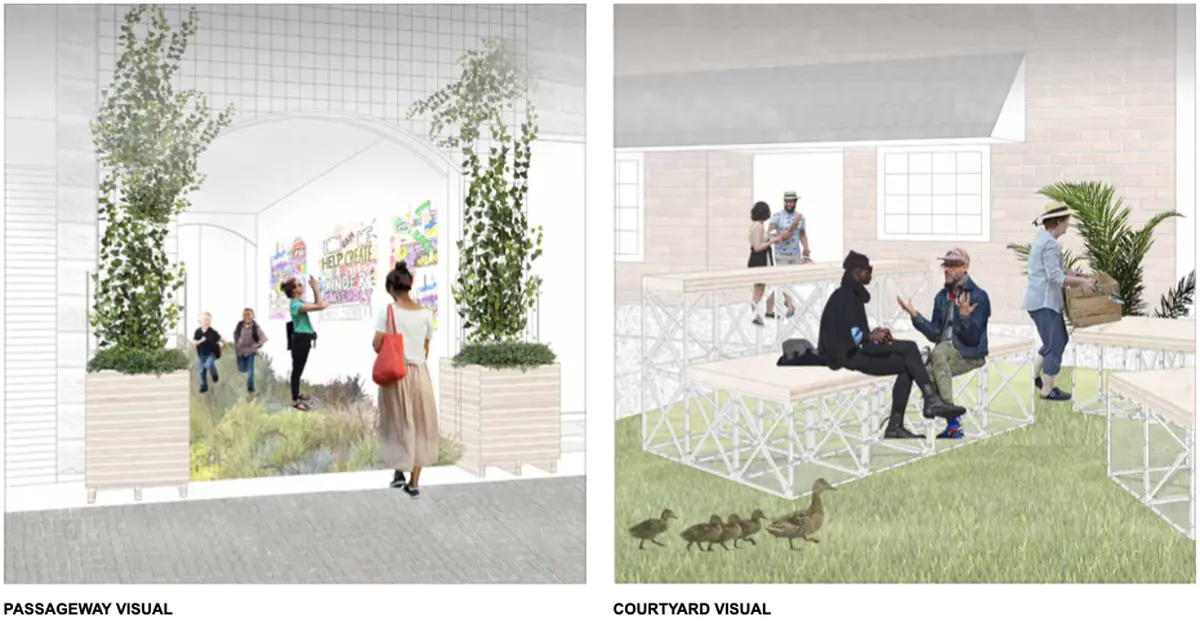
By utilising the passageway to display exhibition work from local institutions it would not only encourage them to create their crafts, it will celebrate their work and the range of crafts that Dudley has.
In this picture from 1914 in Dudley, you can just make out my grandfather. He's the small boy with the cap running across Wolverhampton Street in the days when the trams were still running. Years later we worked out that this day was probably a defining moment in his life, the day he chose never to have a second thought or to be bullied by others. You can see him running. This is because he had stolen the ham you can see him carrying under his arm. This one action started a chain of events for my grandfather that would go on to dominate his formative years. Petty larceny, theft, criminal activity that would shape him, turn him into one of the most notorious villains in the Black Country.
When he died in 1972, this photograph turned up amongst his possessions, in a locked drawer of his bureau. We agreed amongst us that no one in the family had ever seen this photo before, curious as to its importance to him. On the back of the photo he had written the date and time, together with a brief note - "Me stealing ham from W.Smiths, butcher". He would have been 10 years old and this was perhaps his first, or at least one of his first criminal acts.
We have no idea who took the photograph or how he had come to have the original print in his possession, but it appears that it held some significance for him as he kept it all of his life locked away in his bureau drawer.
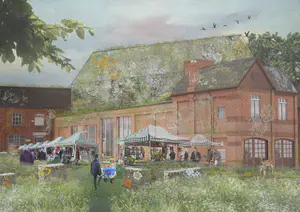
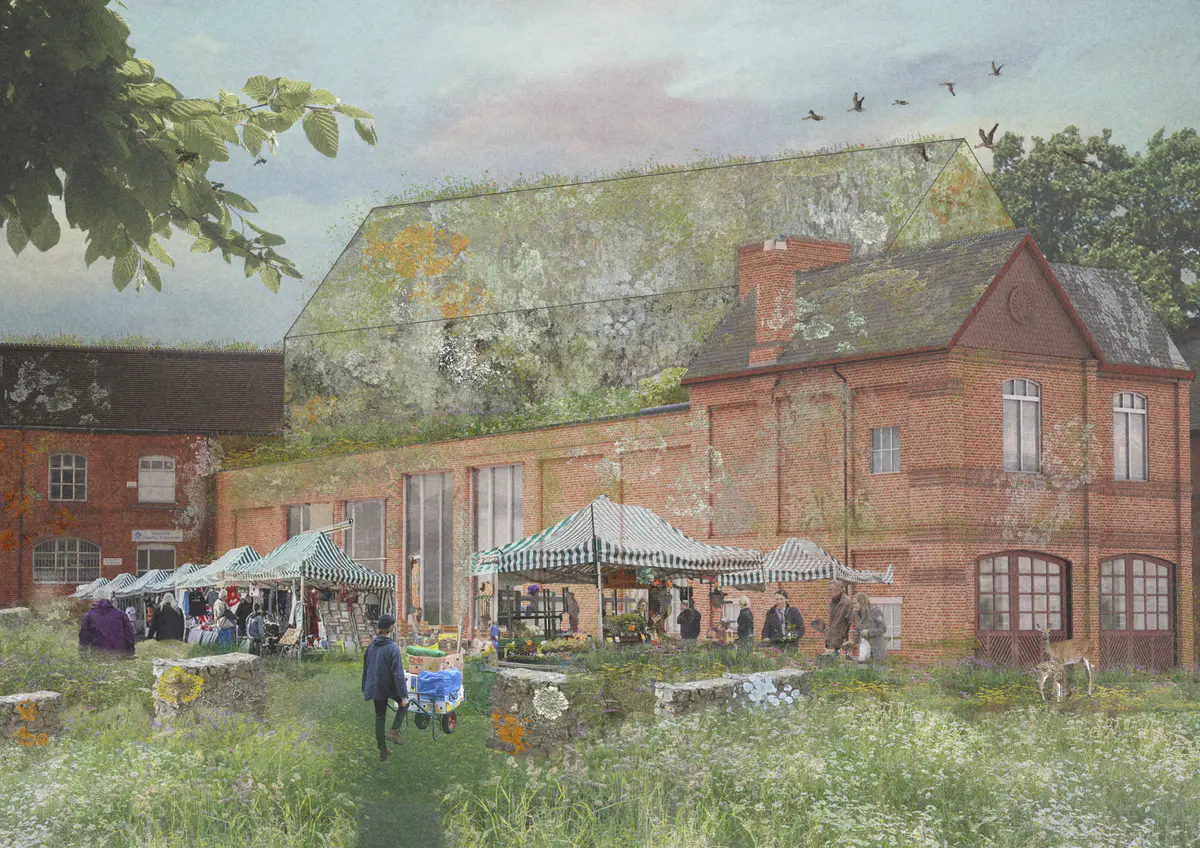
This visual represents the vision for the thesis, buildings covered in lichens, air purifying plants and community activities held on the Highstreet. This visual focuses in on the proposed site for the building and shows expression of a raised new build component on site as well as a full and wild landscaping plan.
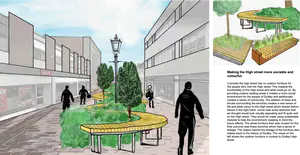
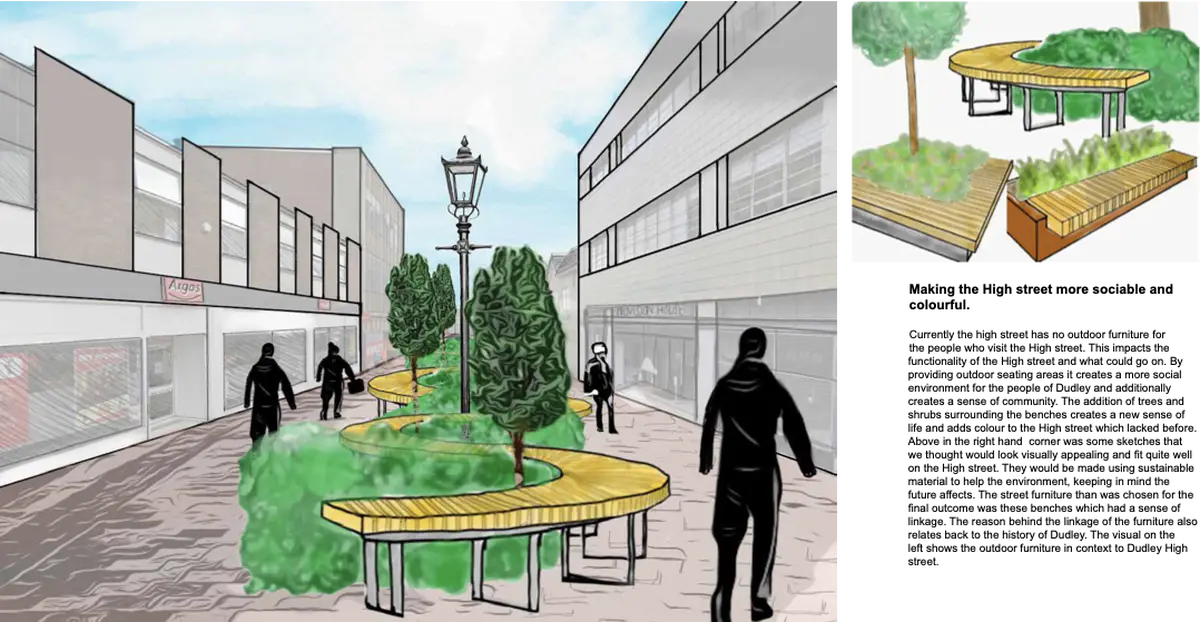
Stepping Stone 2 is about making the High Street bespoke to Dudley through street furniture. We wanted to make the High Street more sociable and colourful. By providing outdoor seating areas, people would be invited to speak to each other and bring back a sense of community.
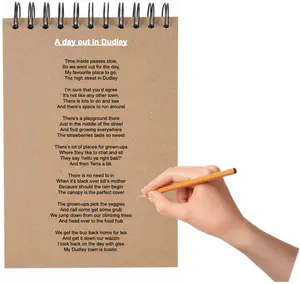
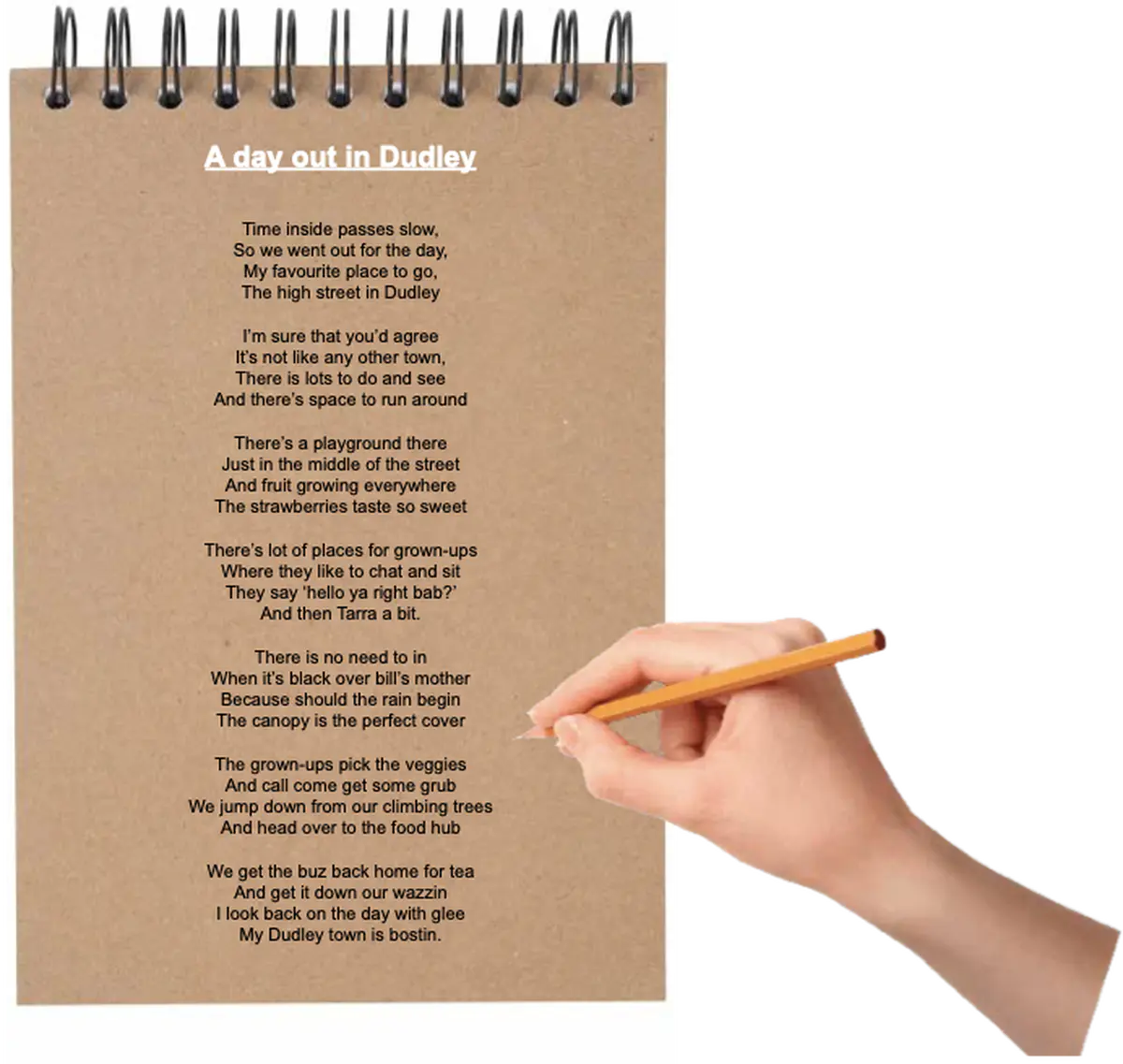
A day out in Dudley
Time inside passes slow,
So we went out for the day,
My favourite place to go,
The high street in Dudley
I'm sure that you'd agree
It's not like any other town,
There is lots to do and see
And there's space to run around
There's a playground there
Just in the middle of the street
And fruit growing everywhere
The strawberries taste so sweet
There's lots of places for grown-ups
Where they like to chat and sit
They say 'hello ya right bab?'
And then Tarra a bit.
There is no need to in
When it's black over bill's mother
Because should the rain begin
The canopy is the perfect cover
The grown-ups pick the veggies
And call come get some grub
We jump down from our climbing trees
And head over to the food hub
We get the buz back home for tea
And get it down our wazzin
I look back on the day with glee
My Dudley town is bostin.
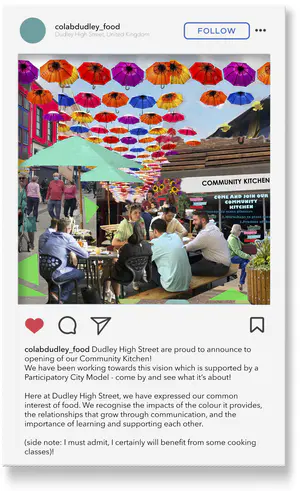
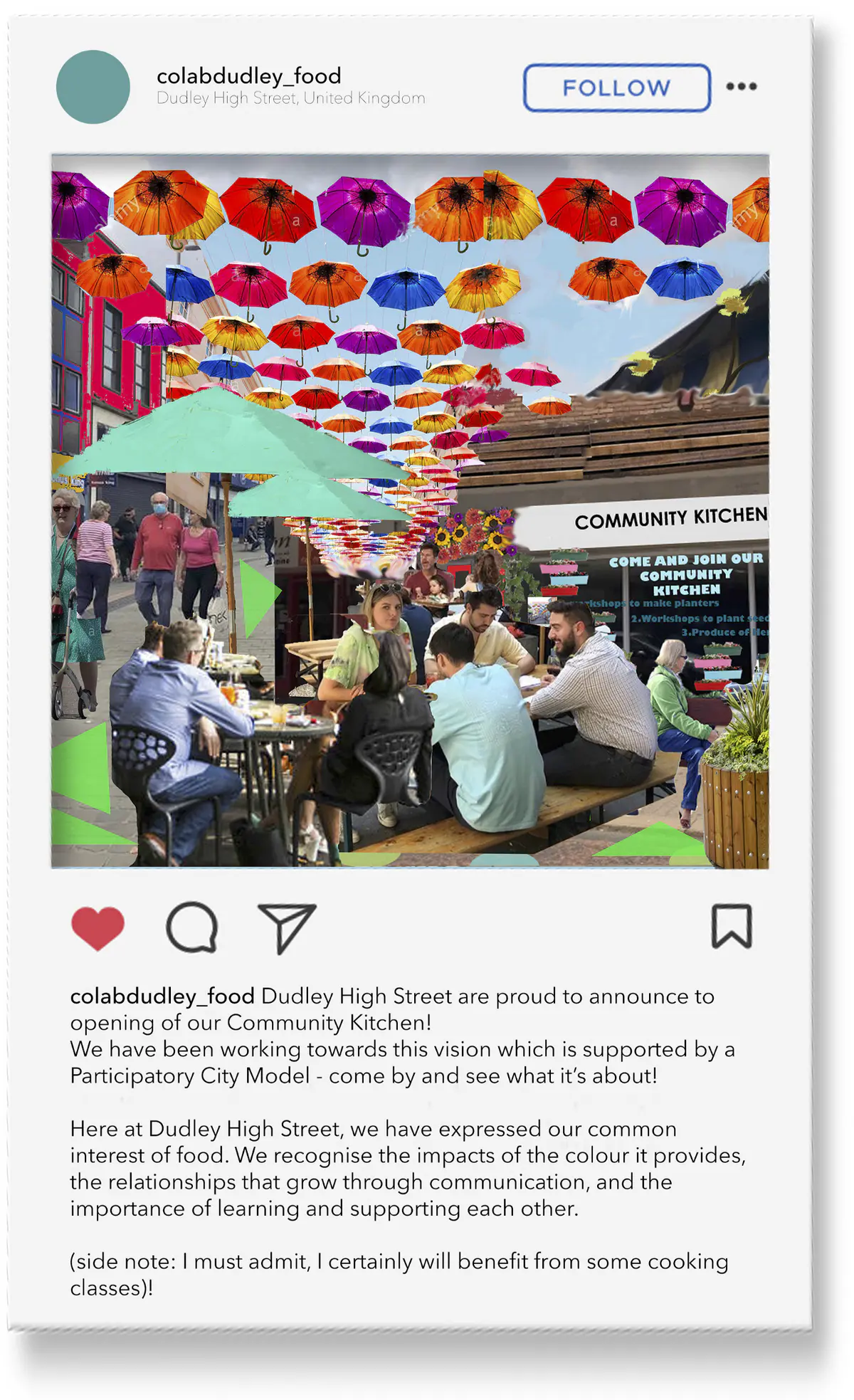
This post promotes the opening of a community kitchen, supported by the Participatory City model.
(We decided to present our narrative through social media and instagram posts as we wanted to showcase what individual experiences might be like when experiencing the future High Street. Each of our posts captures a different element of experience on the High Street to form a collective scenario.)
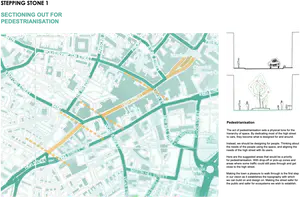
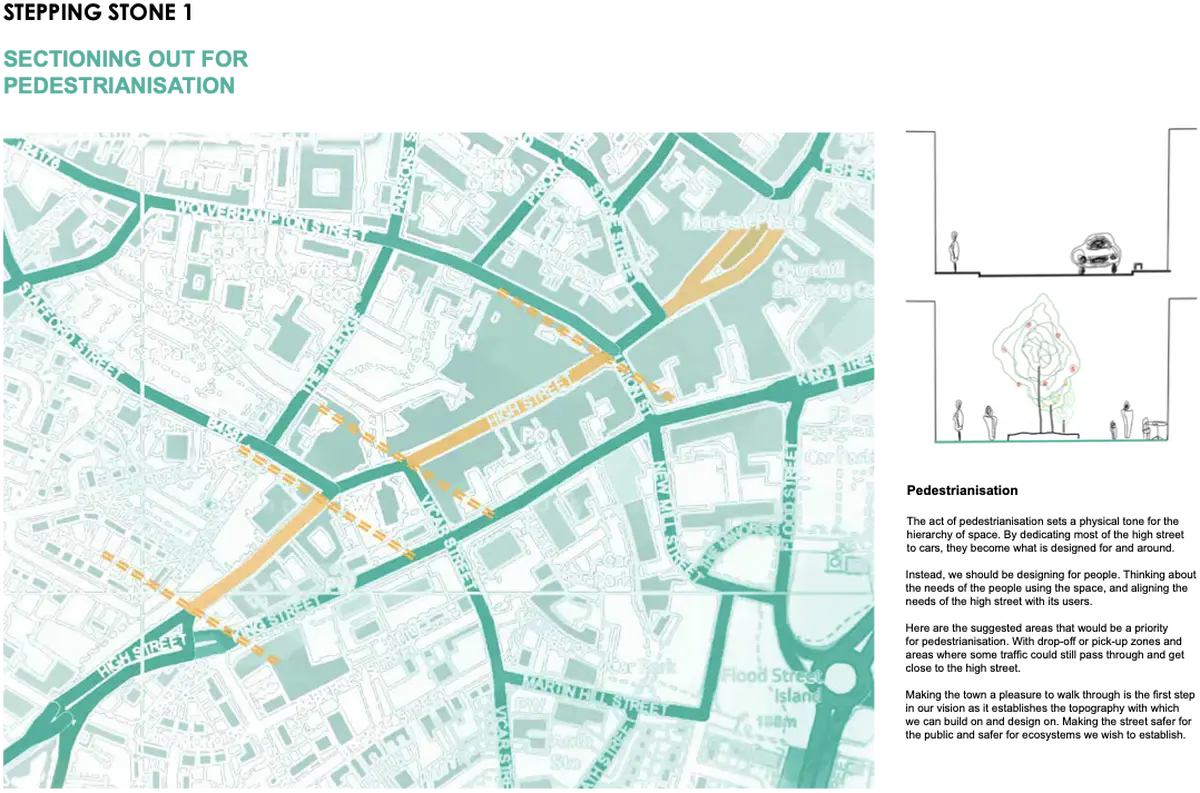
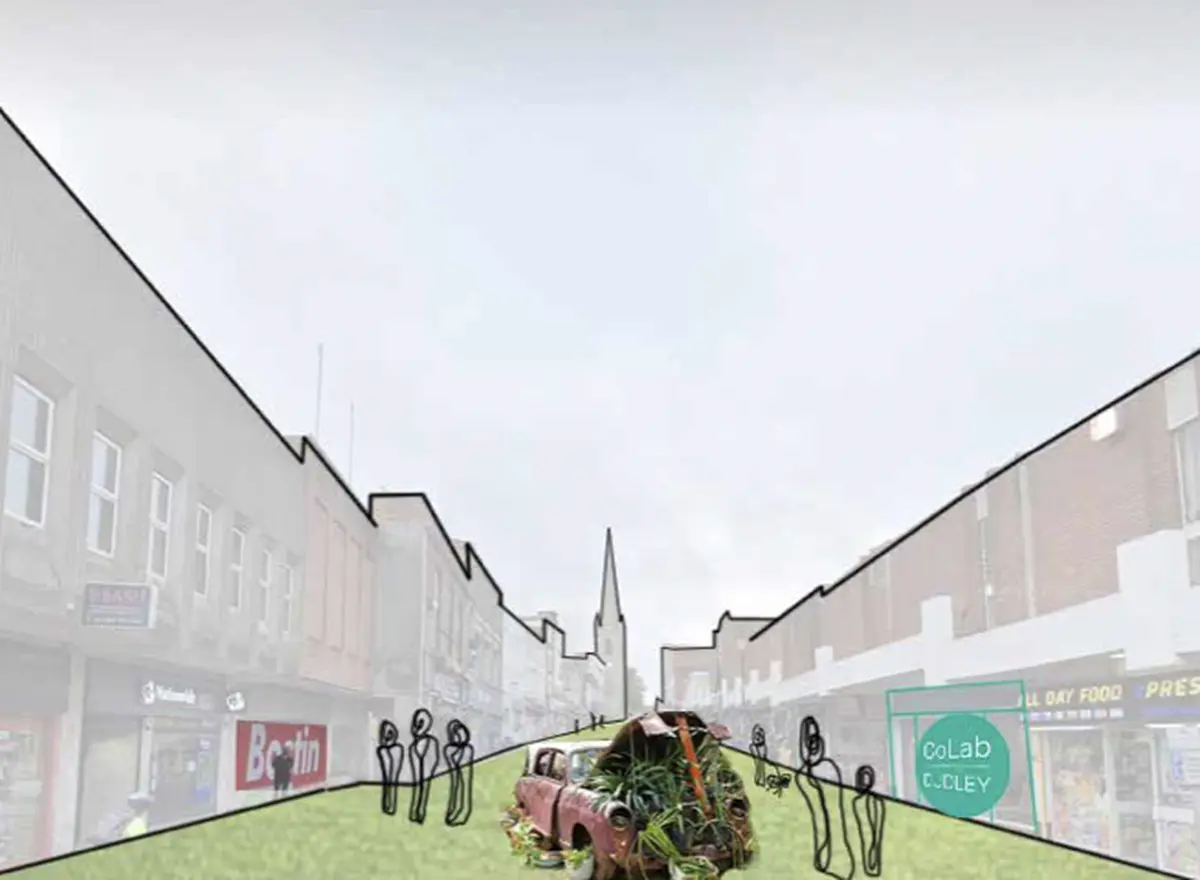
The first step is sectioning out for pedestrianisation. It was important that we did this so we can move down the intervention scale to the next stepping stone; laying the foundation for social and ecological benefits. The hierarchy of space is very much dedicated to cars right now. If you design for cars, you’re going to get more cars. If you design for people, you’re going to get more people. According to Just Economics, the footfall can increase by about 40% following pedestrianisation, and retail follows suit with about 30% increase in sales.
Nurturing AgroEcology in Urban Life
A strategy for living alongside food production
A critical part of the climate crisis is the degradation of soil, leading to scientists predicting the UK has approximately 100 harvests left of stable crop production. As an attempt to address the problem this project will explore the possibility of integrating sustainable agriculture into an urban setting, reducing the strain on agricultural land, reducing food miles and widening city biodiversity. Taking guidance from the farming movement, ‘Agroecology,’ a climate conscious, wildlife supporting and community engaged closed loop system will be developed, combining traditional growing with technology driven techniques that will support each other to produce a diverse plate.
Dudley High Street will be the focal point, reinvented as a destination not just for the purchase and consumption of food but also its creation, driven by the needs and engagement of local people. Connecting the community to the food they eat.
Bianca and her friends went clothes shopping. As they could smell the delicious food making in the community kitchen, they curiously went inside for the first time. Bianca and her friends were offered freshly made, delicious soup.
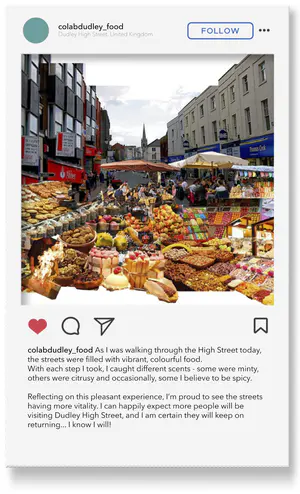
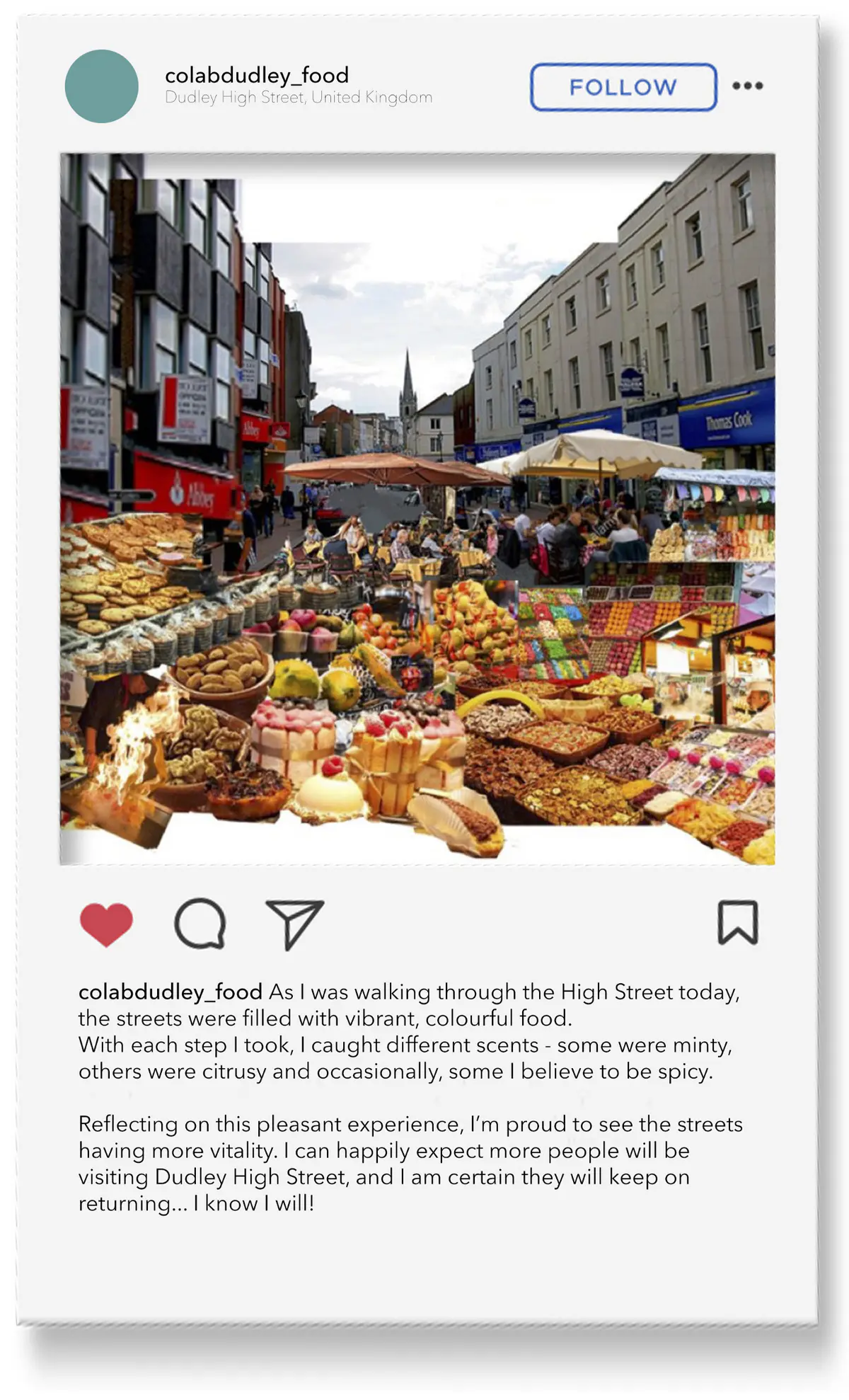
This post captures the street qualities where the visitors experience the colour and aromas of the food.
(We decided to present our narrative through social media and instagram posts as we wanted to showcase what individual experiences might be like when experiencing the future High Street. Each of our posts captures a different element of experience on the High Street to form a collective scenario.)
We feel that our local High Streets should be the focal point for our local community. They should be seen as places of interest and a place where you can go for both essential items and leisure. Therefore, we feel making the High Street pedestrianised would mean that there is a larger space to work with on the High Street and that it will not only allow locals to shop but also congregate and relax with family and friends.
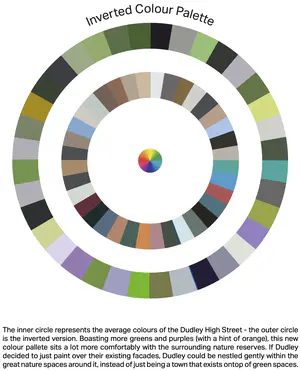
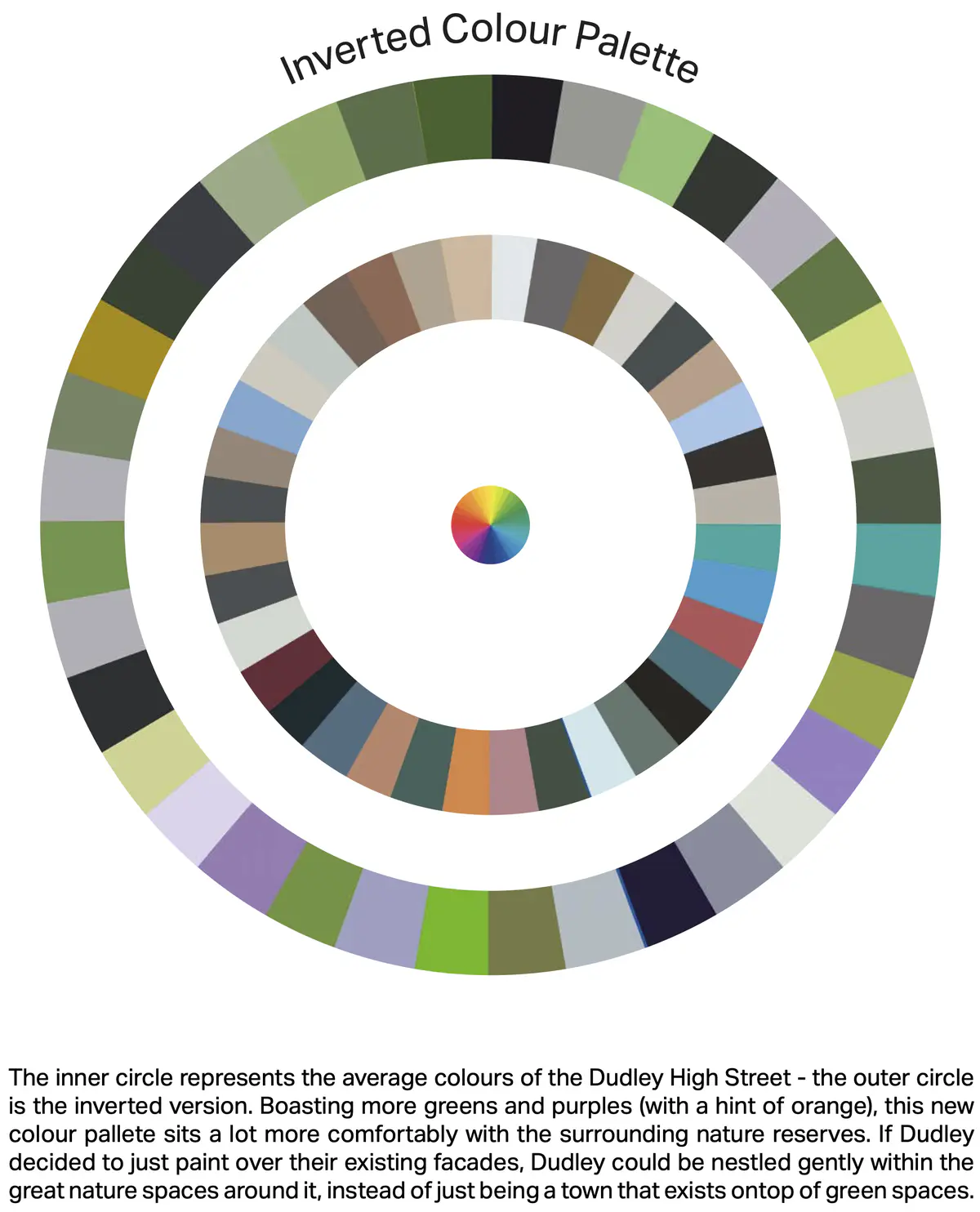
The inner circle represents the average colours of the Dudley High Street - the outer circle is the inverted version. Boasting more greens and purples (with a hint of orange), this new colour pallete sits a lot more comfortably with the surrounding nature reserves. If Dudley decided to just paint over their existing facades, Dudley could be nestled gently within the great nature spaces around it, instead of just being a town that exists ontop of green spaces.
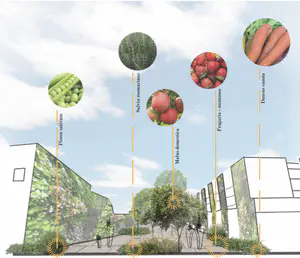
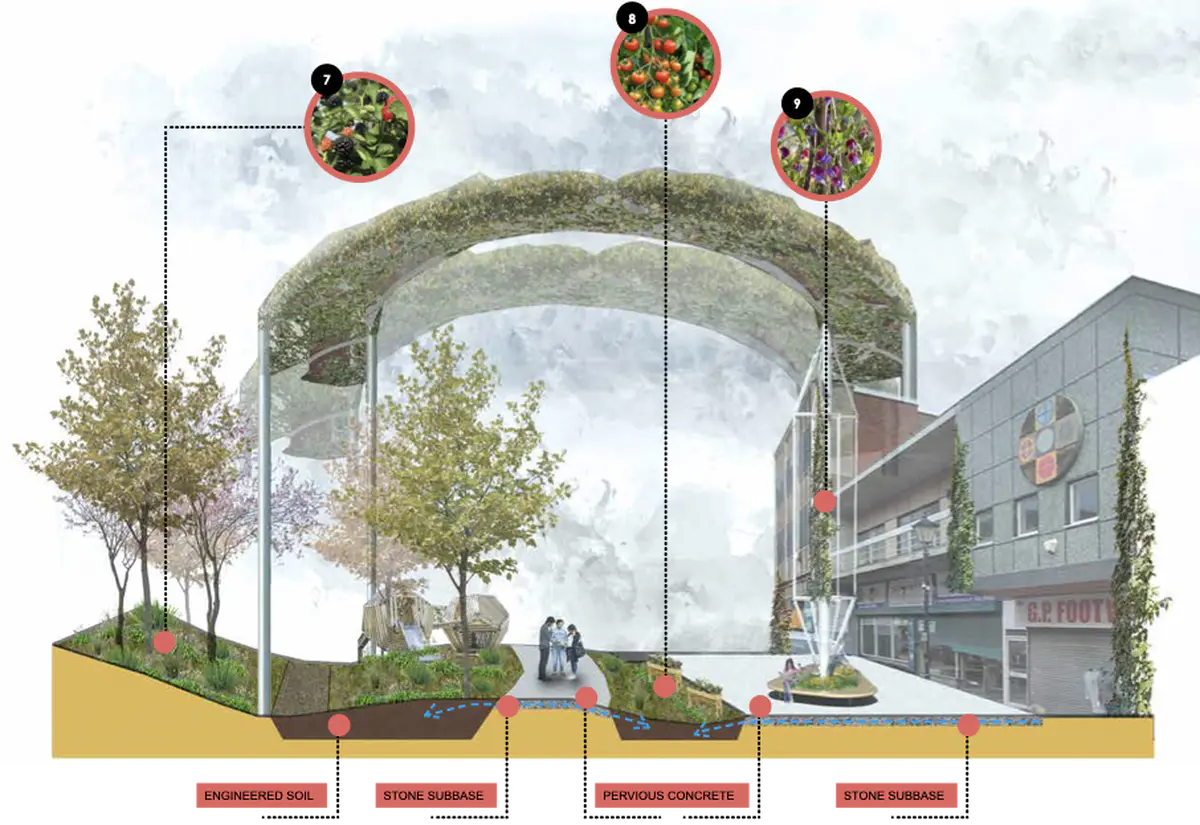
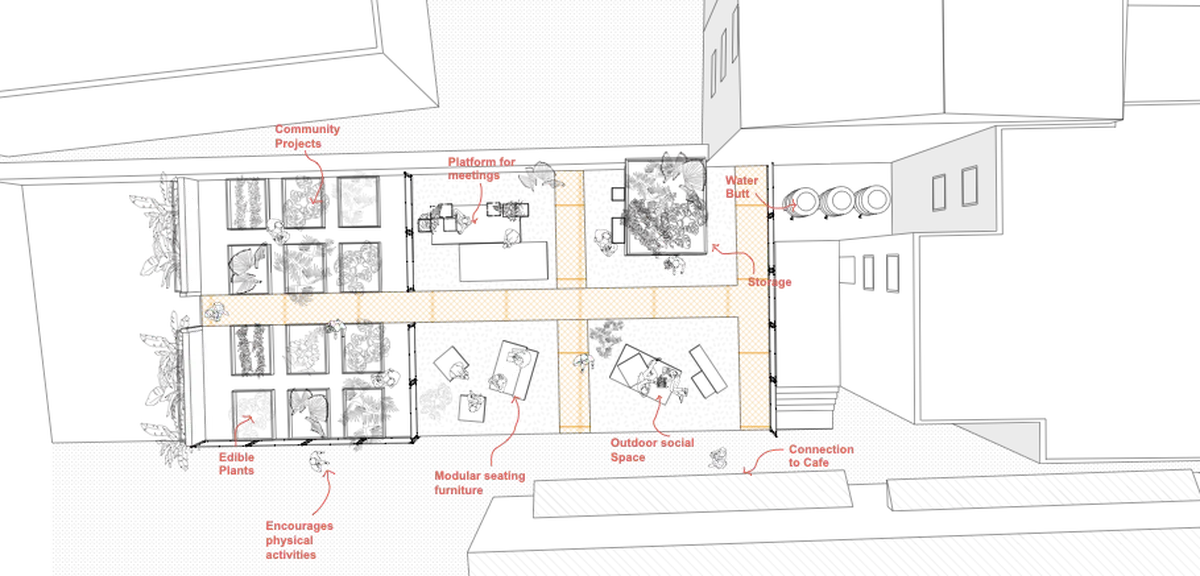
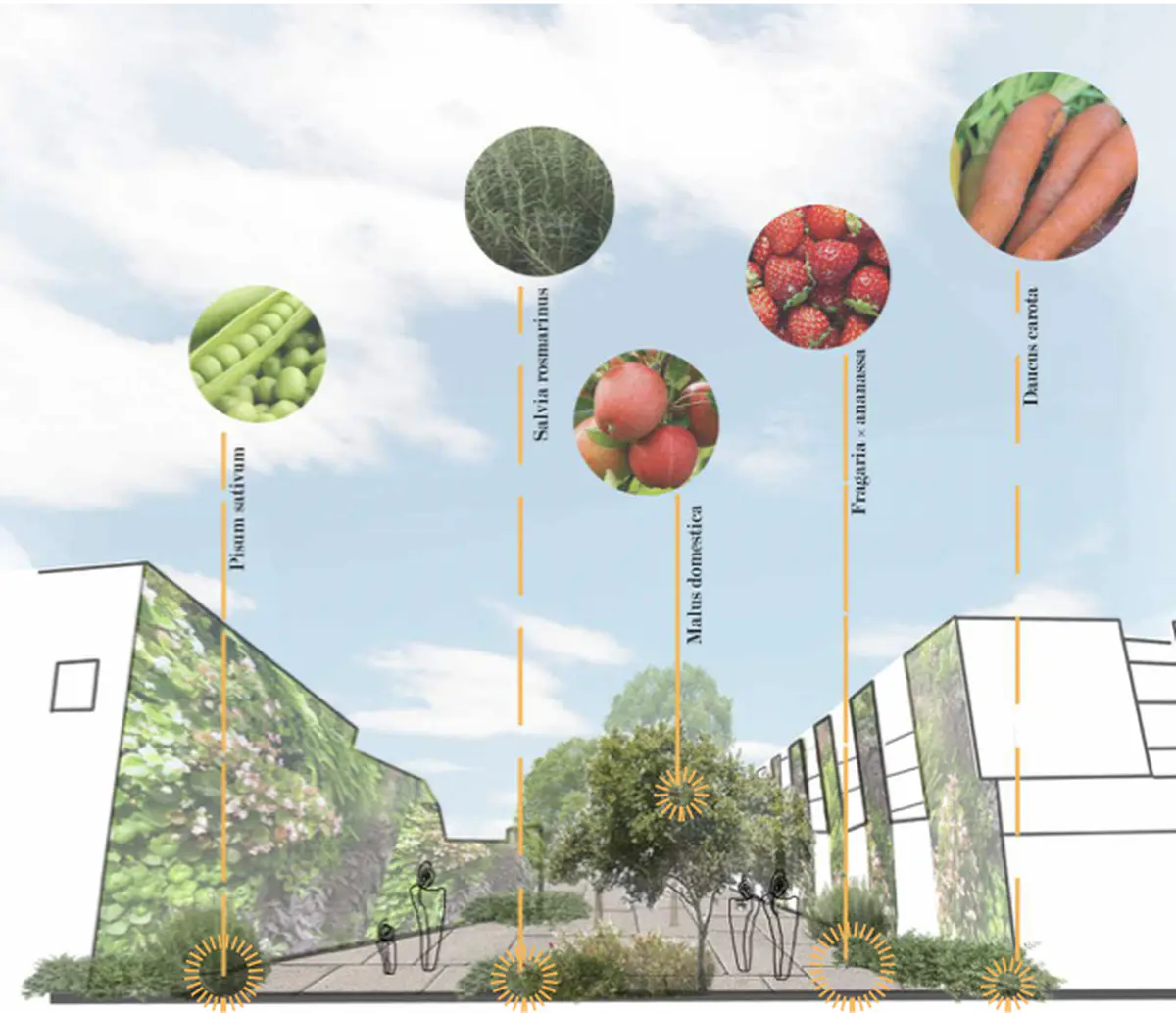
The image shows what this space could look like as a productive landscape. Where all the space is used. Vertical growing space can be utilised for pollinators for heights out of human range and for fruit and herbs in the lower regions that lie within our grasp. Trees can provide shelter, pollen and fruit, as can shrubs.
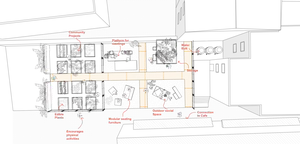
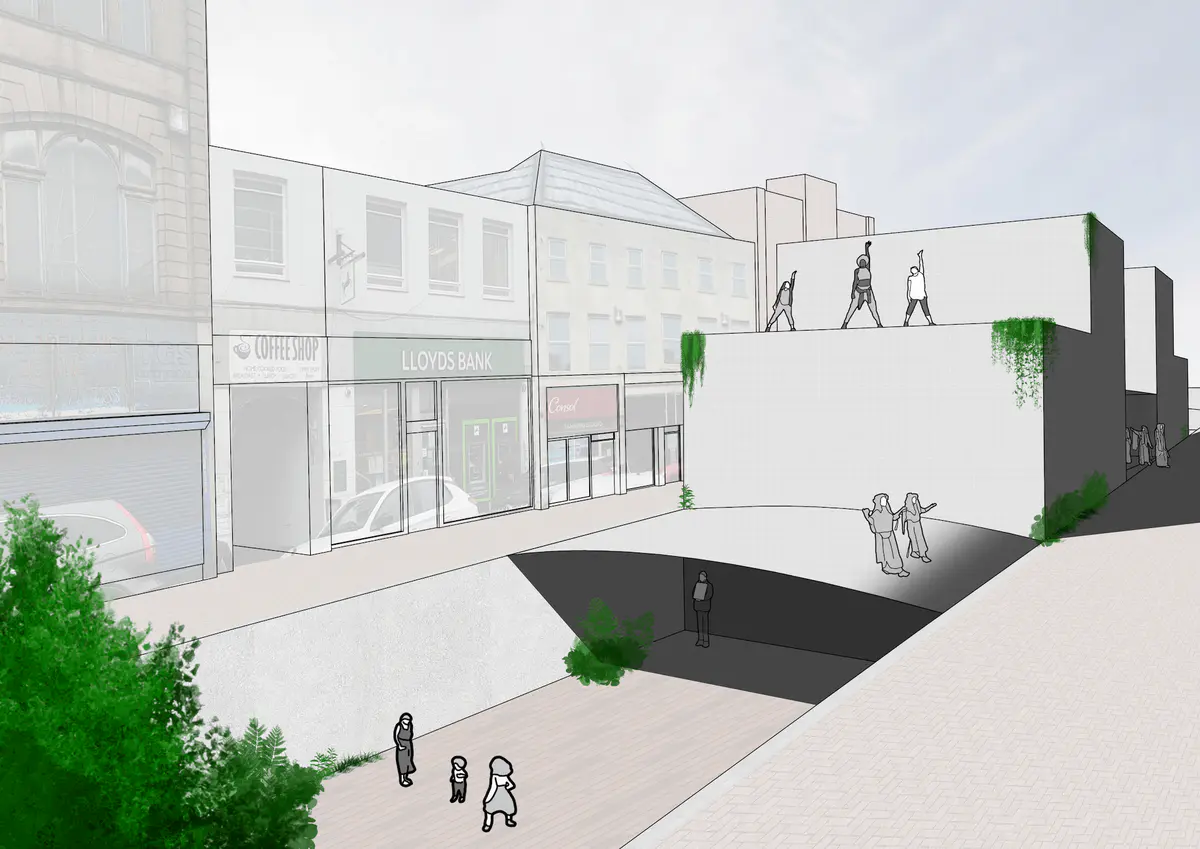
The main structure would have various spaces such as the Museum space, possibly a place that people can pin up local activities, and maybe rooms for either changing or for performance practice. As the street is 11m wide on average, there is plenty of space to have the building
fill the space. As the sunlight comes from mainly the south, the south side buildings often shadow the street entirely, which would mean that something being built (especially as it will be dug down a bit) would not shadow out the other buildings. The biggest hurdle to tackle is
that the space shouldn’t not feel overwhelming to the other shops or those who walk down the pavement. Because of this, most of the building’s structure would be in the underneath area, and only parts of it would pop out over the pavement. As the design would be flush
with the pavement, there are also opportunities to have crossing bridges that are both useful by the public, but also incorporated with the design of the new street.
The back of the street would create a unique space for social activities. The space is wide enough and long enough for a performance theatre space to be erected there, but it also has the possibility of having some kind of altered shape to the area, like a raised platform that could house
seating and other social activities. However, the space can also perfectly fit a fully regulated tennis court, badminton court, and volley ball court. People have mentioned that there is also a lack of sport engagement in the area, so this could be used to provide that kind of space.
A sketch showing workshops utilising the empty spaces, street furniture, canopies on the side, and street art to brighten and liven the current High Street.
A collage response to a Co.LAB gift for the High St - “It was nice to be able to use the image for something else. It made me think about placing the cut-out roadmap onto a slightly brighter future version, with colour, vibrancy and plantlife, so that it reminds me what we are heading towards, but still with a hark back to the people and the industry that made Dudley the town it is...”
Jack and his friends visited the High Street with their school teacher during a study trip. He learned a lot of things about sustainability, and how to grow food. He was so inspired. Atifa gave him some seeds from fruits on the street garden, and later he planted them in a small unused bucket. After a few months he came back to street to gift the kitchen some of the fruit from his tiny garden at home. Atifa felt so proud of the young generation of Dudley.
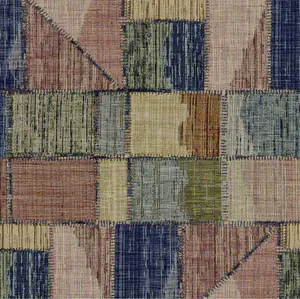
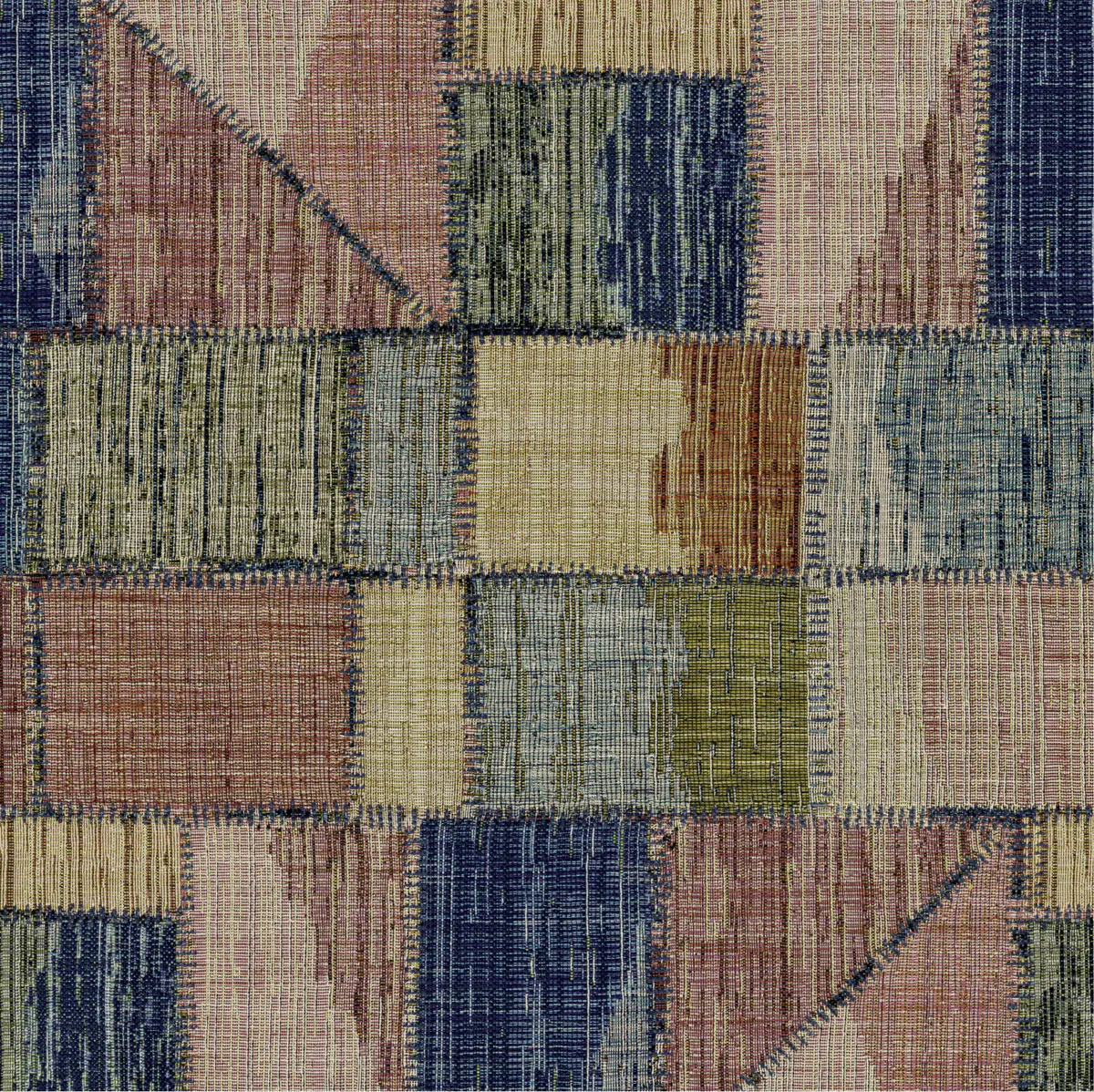
Street scale patchwork
Investigating Facade Damage will highlight where the repair needs to be undertaken.
It is creating an irregular pattern of repair that evolves.
Only intervene when necessary; this proposal will not ‘repair what does not need fixing’ as it appreciates there could be a negative effect on an already declining high street.
Repairs will be constructed with the materials grown on the street as part of the Macro-scale intervention.
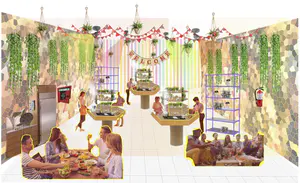
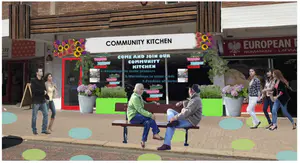
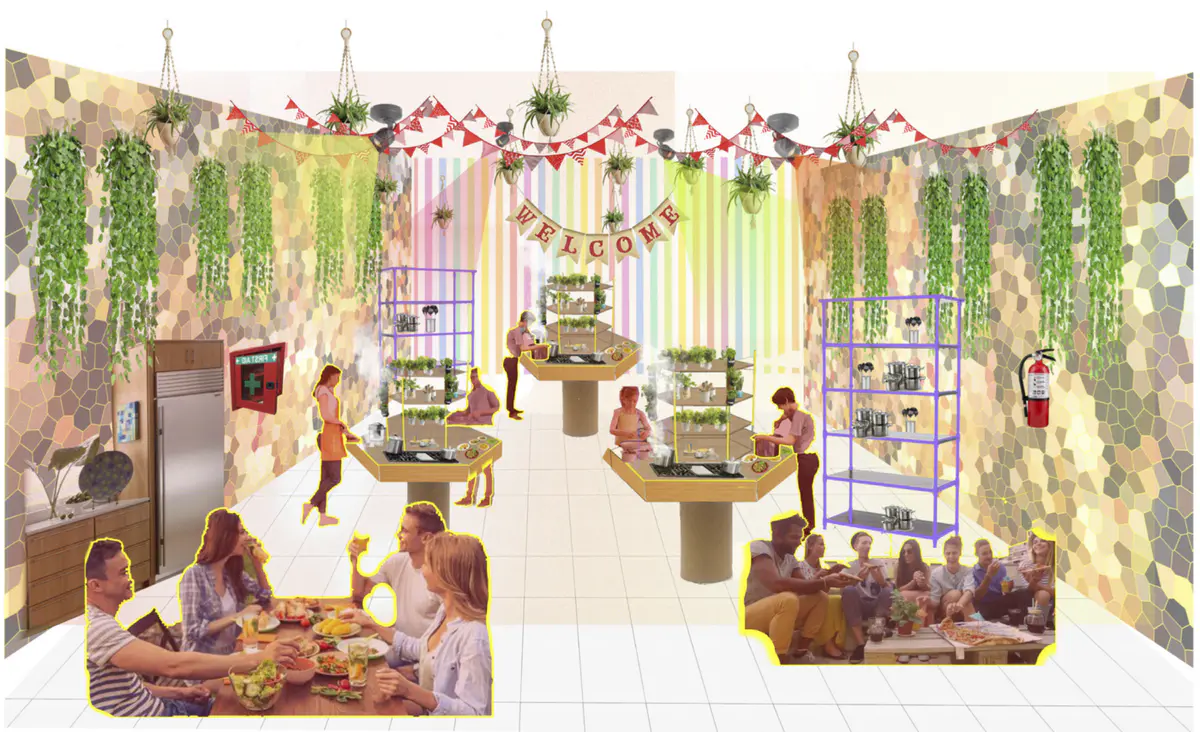
The interior of the community kitchen would be inviting and colourful to create a positive atmosphere. The colours were abstracted from one of our group collages of food. The kitchen counters are not considered as a back of house element; they have been combined with seating as we are trying to embrace the cooking process. The kitchen desk is designed in a way so multiple people can work together from all sides, with central storage for herbs.
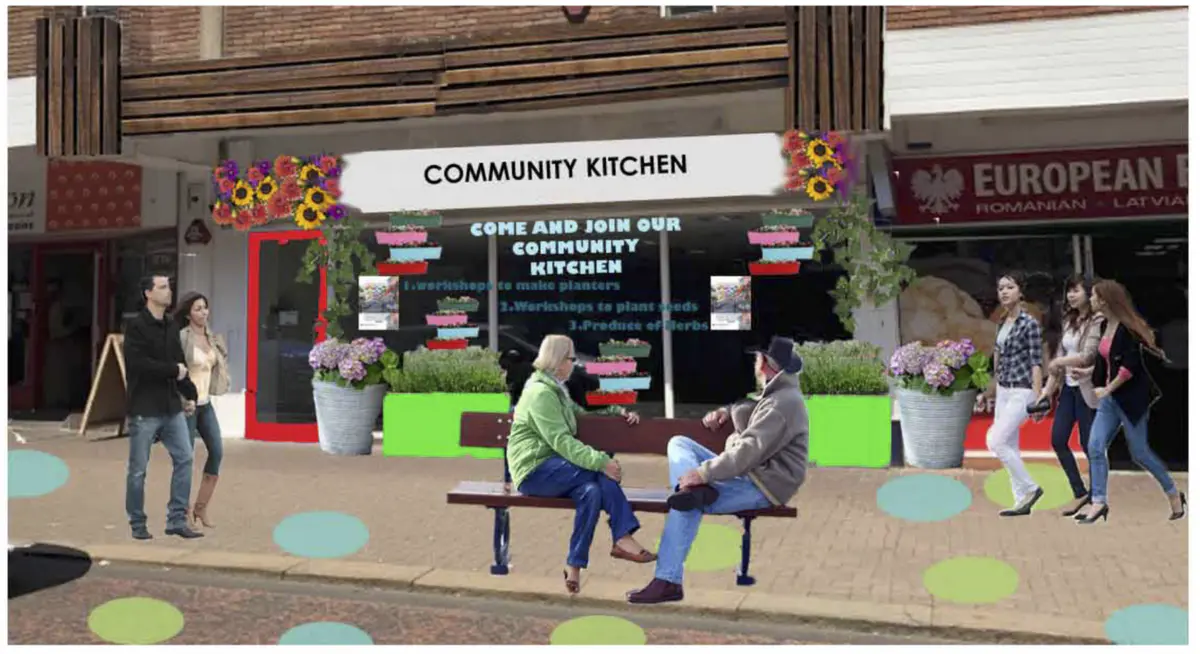
The facade of the kitchen contains a small window so food can be sold outside. We have also created a vertical herb garden so it can be used in the community kitchen. We wanted to keep these below eye-line so people outdoors have a clear view into what’s going on inside.
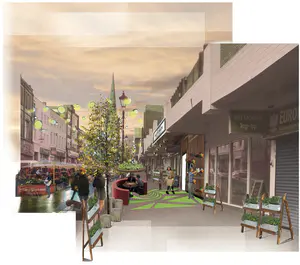
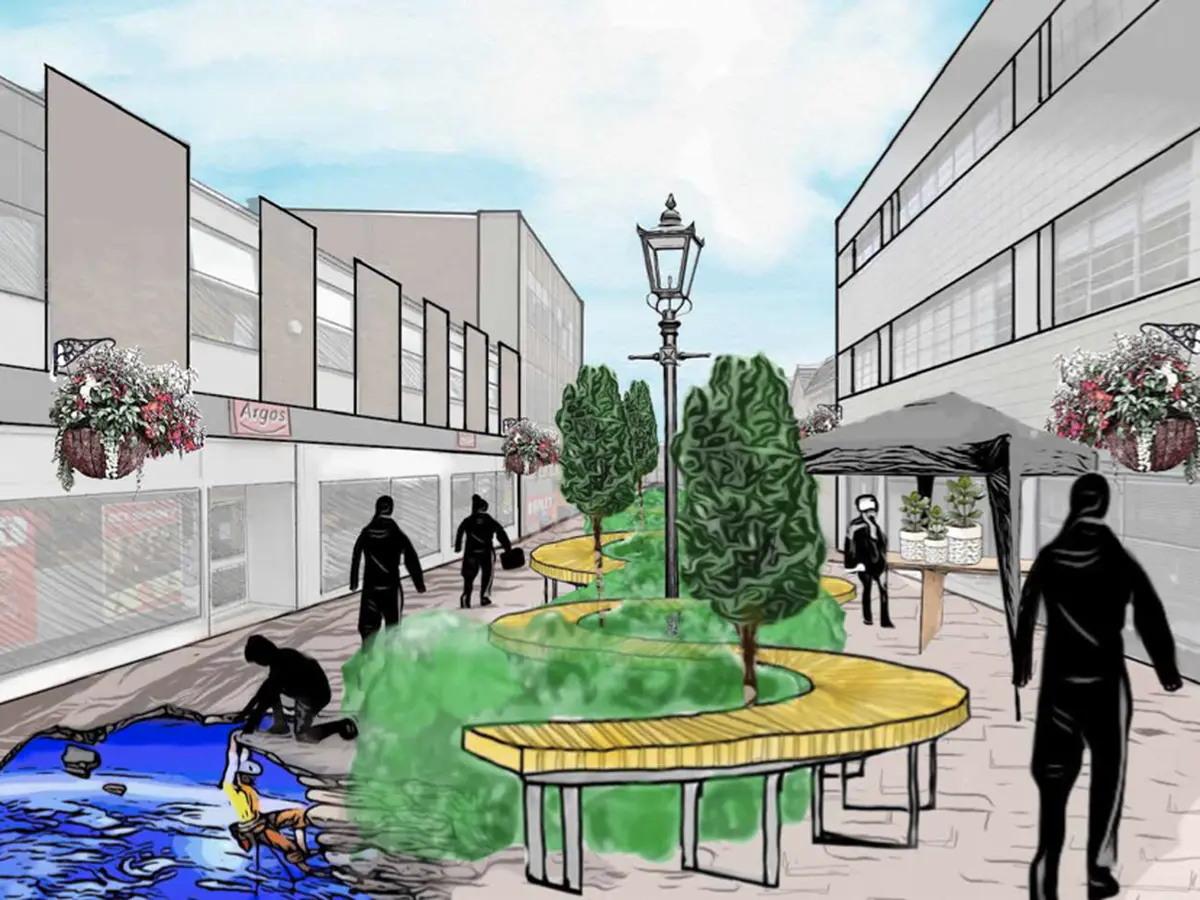
This street section shows activity from the back of the community kitchen to the other end of the street and how all these elements are working coherently. The street is filled more with people rather than cars. We believe that the outdoor seating, more trees, canopies and street lights can attract people to connect with the High Street.
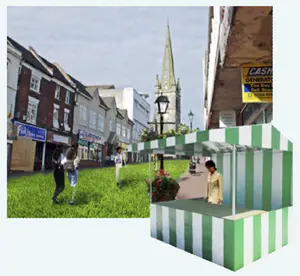
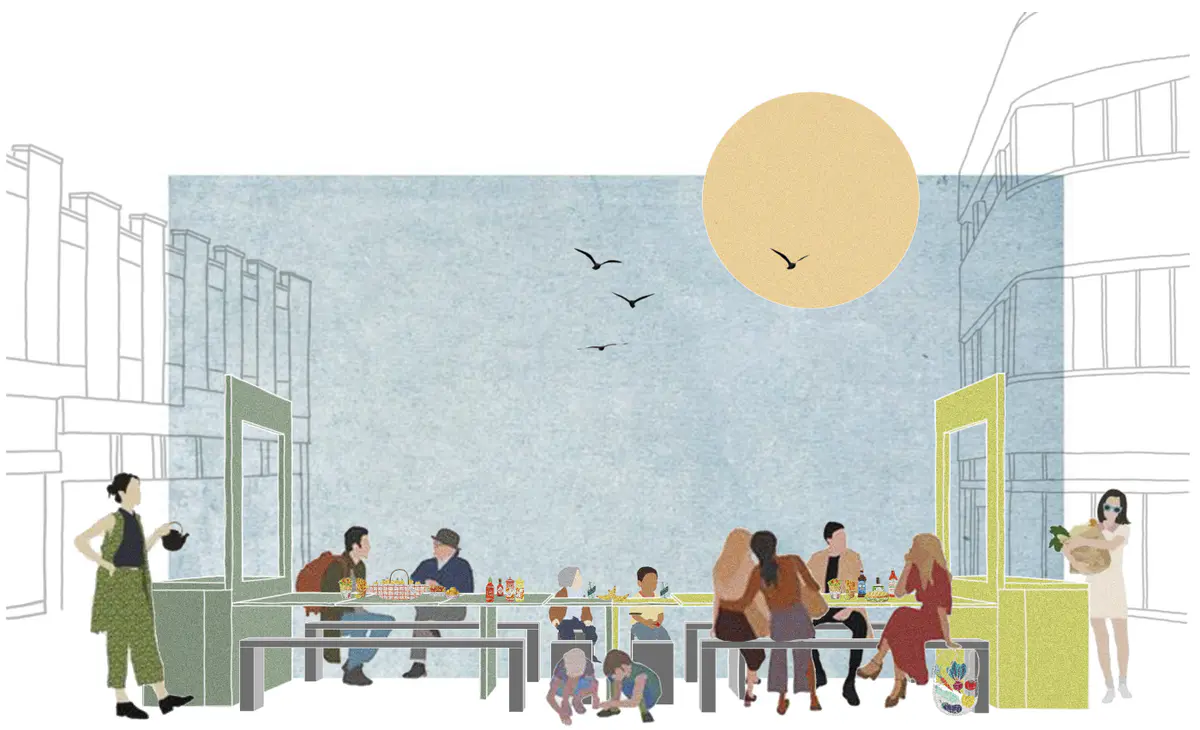
The first Stepping Stone project looks into designing multifunctional furniture for Dudley High Street to provide opportunities for a regenerative community, focusing on how the high street can be occupied with resilience. Initially, the stalls act as market stalls to provide opportunities for enterprises and small businesses to begin thriving and encouraging the High Street to become a place of inclusivity.
However, the stalls can extend out into outdoor seating arrangements, which can become an extension of the community kitchen and during events can become a part of the whole atmosphere.
By extending the furniture, they can connect together and become a large spread where people can sit together and enjoy company. It creates a lowered centre space so children can sit together, or paint on the surfaces. We decided to focus on furniture because we felt the importance of it can go unrecognised. We felt through the design of this market stall, many memories can be created and attached to these items, and become valuable assets within the community.
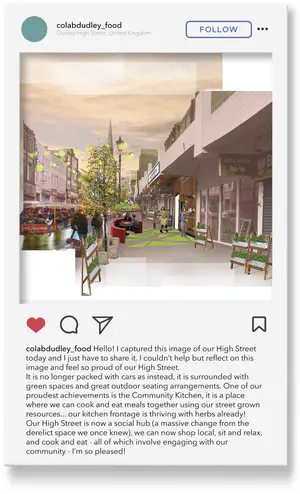
This post develops what the community kitchen has to offer with street grown resources and community engagement.
(We decided to present our narrative through social media and instagram posts as we wanted to showcase what individual experiences might be like when experiencing the future High Street. Each of our posts captures a different element of experience on the High Street to form a collective scenario.)
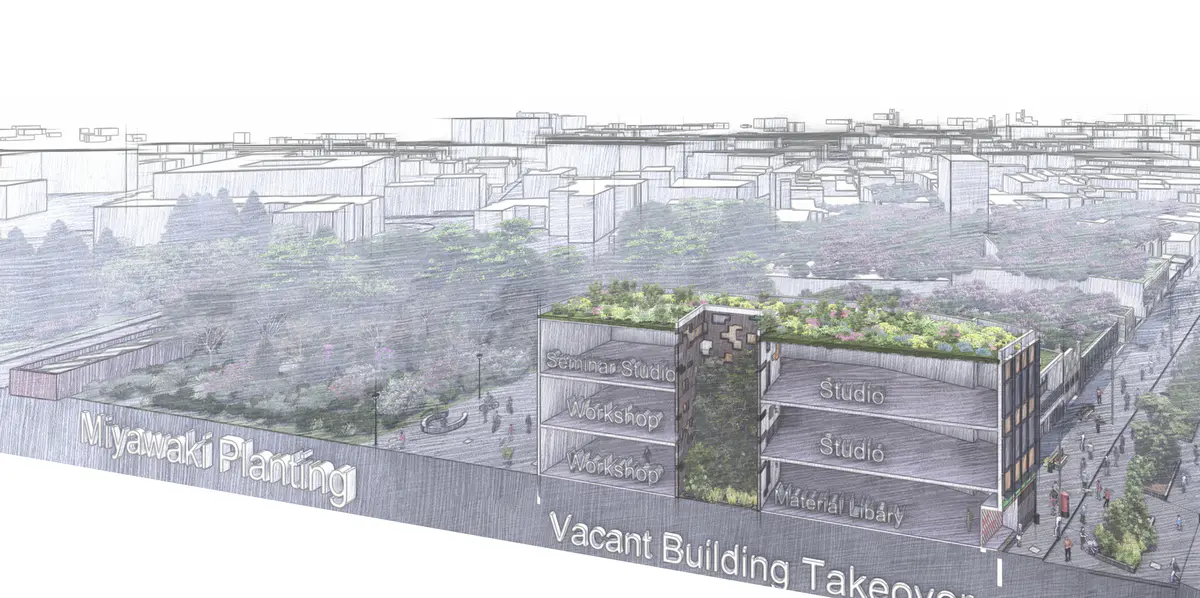
Explore The History Of Site Voids - This will provide an opportunity to reimplement these to allow vertical green corridors to occur.
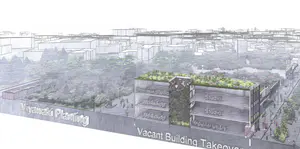
Explore Vacant Buildings - To avoid damaging an already deteriorating high street, I aim only to take over vacant plots.
Investigate the opportunity for Miyawaki planting - understand the conditions required to grow a sustainable material source on-site, including ground, water, and space conditions.
It takes over a building that leads directly to an open space where a community hub is the centre of the thesis, offering education, community engagement and material celebration.
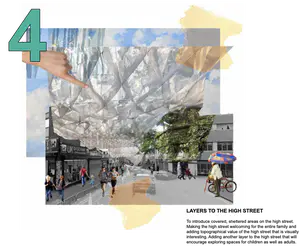
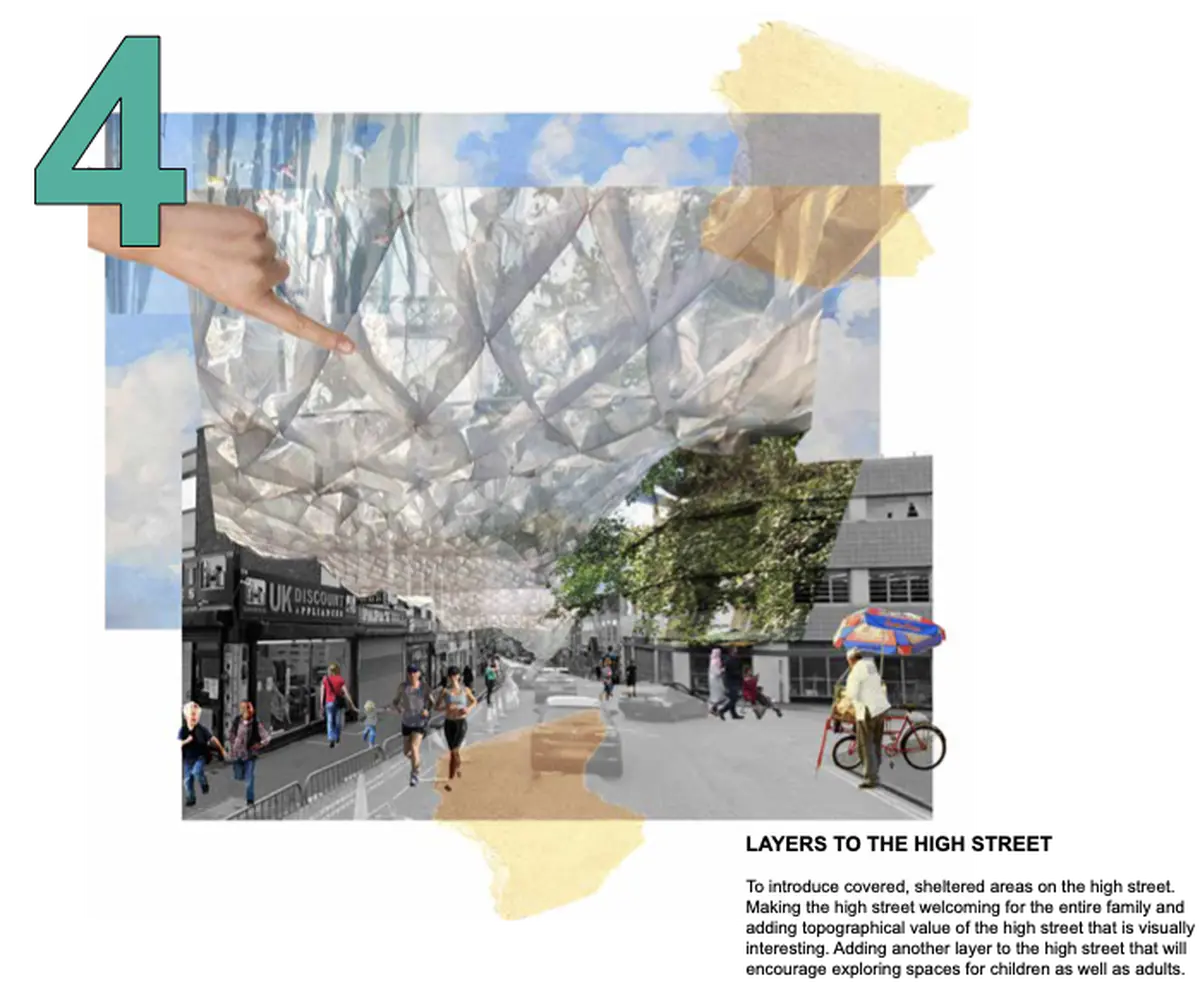
LAYERS TO THE HIGH STREET - To introduce covered, sheltered areas on the high street. Making the high street welcoming for the entire family and adding topographical value to the high street that is visually interesting. Adding another layer to the high street that will encourage exploring spaces for children as well as adults.
A More-Than-Human Story of Dudley High Street
This story is a collective outcome after utilising completed Street Detectorism maps, and More-Than-Human findings to create of 'A More-Than-Human Story of Dudley High Street'.
As part of a dissertation study, this workshop invited participants to share their imagination and develop stories from the previous findings on Dudley High Street. This story creatively archives nature on Dudley High Street, with emphasis for the value of storytelling and nature at the forefront of this task.
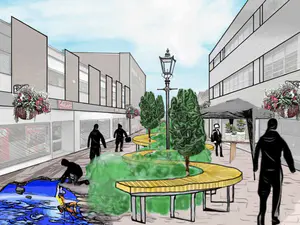
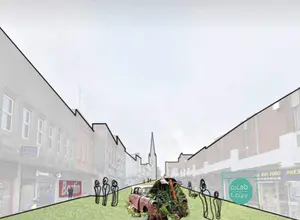
New use for cars — As part of pedestrianisation we would like to suggest a memorial of sorts to cars. The feature would sit in the middle of the High Street and would consist of an old out-of-use car, being used as a planter and being filled with plants. This gesture symbolises the movement of the High Street’s priorities shifting from the automobile to plants, people and food.
The third Stepping Stone project attempted to design the community kitchen in one of the empty shops on Dudley High Street. We all know that food is an essential factor in our life and eating and cooking the food is not an abstract activity we do, it is part of our everyday routine. In our initial research, we found that many people live alone in compact housing on the High Street. We thought the kitchen connect the residents with society. We decided to make the process of preparing food more enjoyable. As our aim was to grow food on the street wherever possible, we can use these vegetables for the community kitchen. This will encourage residents to come down onto the street and engage with it. This could also be a new experience for the visitors of the High Street.
The second Stepping Stone project focused on the representation of colour and revitalising frontages. During our group discussions, we recognised the negligence of existing colour on Dudley High Street. Colour is a key element we believe can bring a sense of brightness into the High Street, and an element that should be of focus when revitalising the frontages.
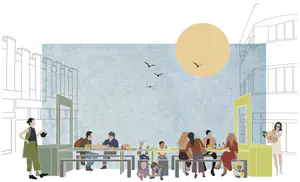
In this example, we have approached the frontage for the community kitchen we envision. The visual showcases a Community Kitchen in which different herbs and spices can be grown. These can then be used to cook the many dishes respective to the different cultures existing on the High Street. Each frontage can respond to the different uses of the buildings to promote individuality across the street.
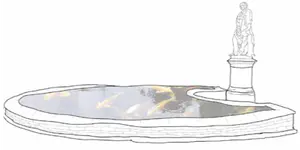
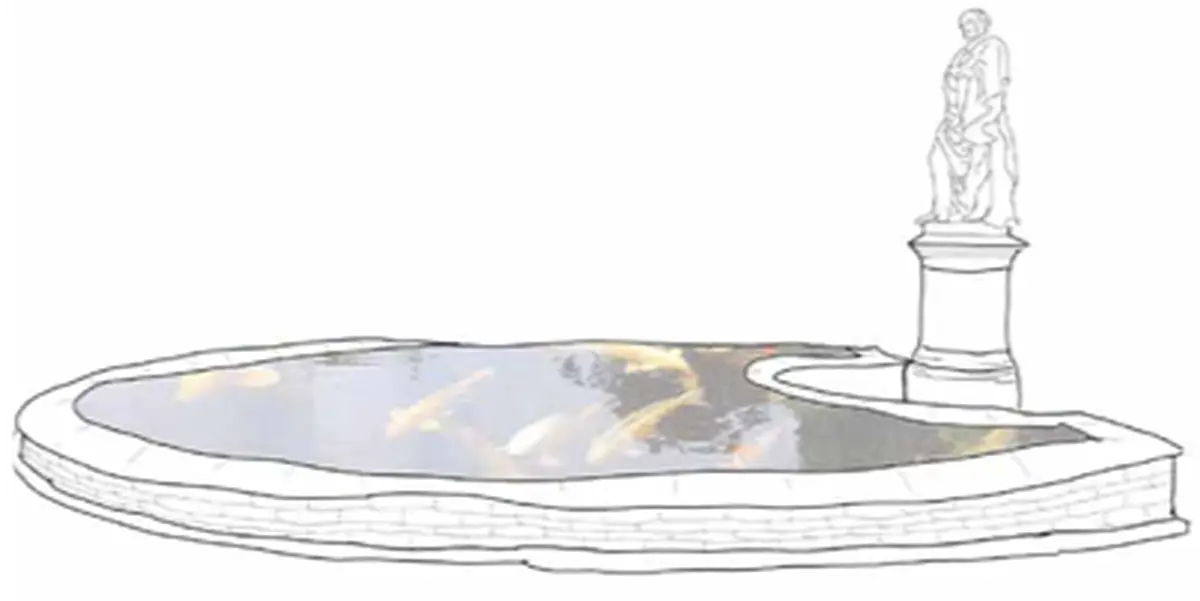
Pond — At the northern reaches of the High Street lies a raised bed with nothing but a sterile patch of grass. We suggest as a miniature stepping stone, we replace the grass with a pond. The sounds of water can soften the noise of the traffic and it will invite pedestrians onto the high street by having this point of interest. It also works with the plans for re-wilding and growing food along the High Street as it aids pollination.
By placing a community garden in this space space you can learn how to plant food and it will lead to more edible spaces on the High Street that will then lead to the re-wilding of Dudley.